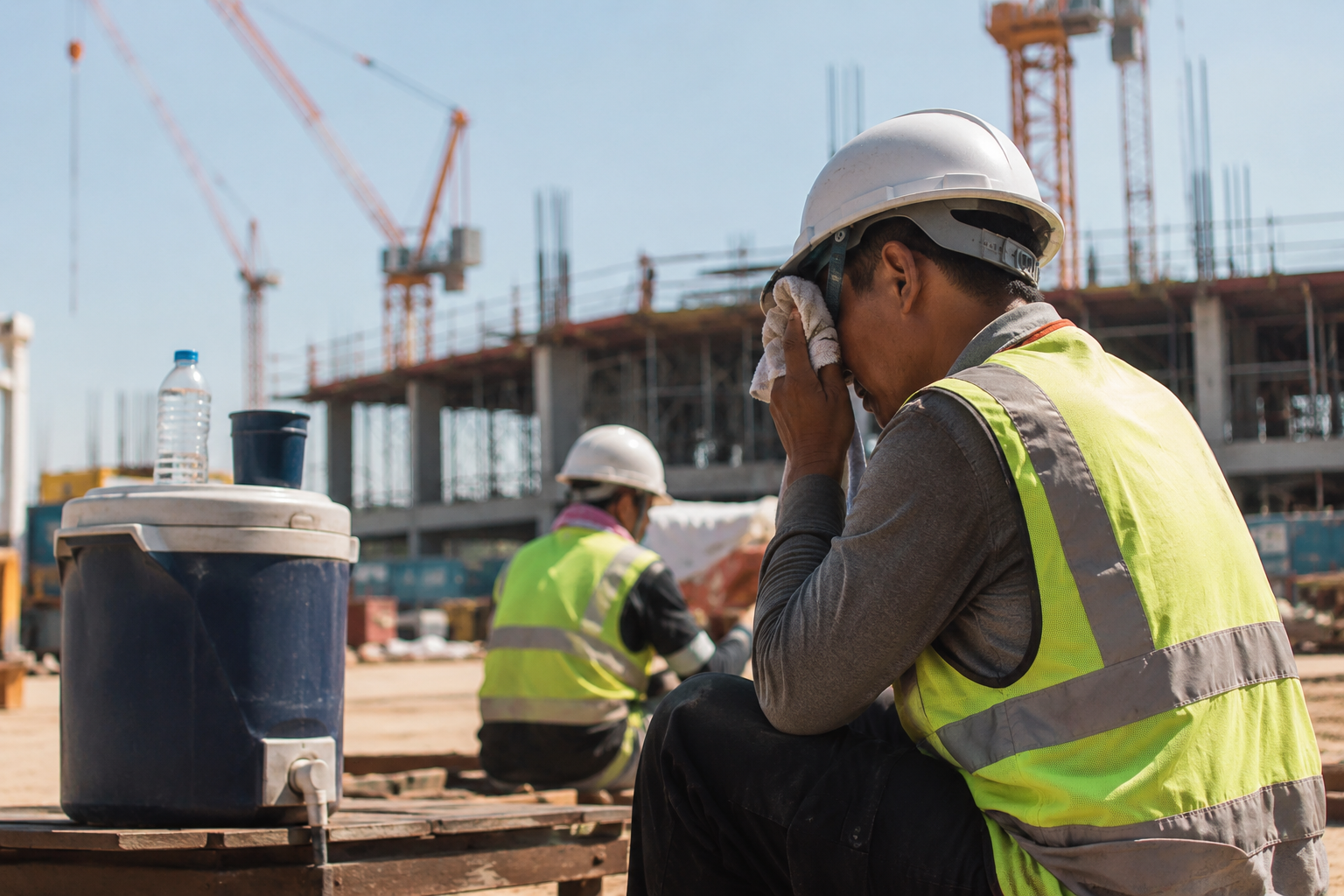
With the summer heat arriving earlier than usual this year, not only the government and local authorities but also construction companies are working hard to prevent summer accidents at construction sites.
Summer safety manuals and campaigns, which are typically distributed in June, have been brought forward to May this year. This signals
that seasonal risks such as heatwaves and torrential rains are no longer just “summer occurrences” but have become “constant variables that must be managed starting in early summer.”
In this article, we will summarize the measures major construction companies have taken to respond to heatwaves and torrential rains, and highlight one structural challenge that these campaigns all point to.
According to the construction industry, several major construction companies have been simultaneously rolling out measures to prevent heat-related illnesses and prepare for the rainy season since May.
Temperature-responsive workwear and cooling equipment
On the 27th of last month, Lotte Construction unveiled a "Heatwave Alert Uniform" campaign featuring special color-changing ink. The system works by
changing the color of text on the workwear to a message advising workers to take a break when the temperature reaches 33°C.
The company stated that while this is still in the campaign phase, it will consider implementing it on-site if it is deemed effective in preventing heat-related illnesses. It is already implementing measures such as providing ice water twice a day, installing portable air conditioners in break rooms, and setting up outdoor shade structures.
On the 28th of last month, SK Eco Plant signed a business agreement with a beverage company to provide cooling supplies—such as cooling towels, cold packs, and sports drinks—at on-site rest stations.
Temperature-Based Response and Use of the Right to Stop Work
Daewoo E&C is launching the “3335 Campaign” on June 1, which involves a tiered response based on temperature. The campaign is divided into three stages: adherence to preventive guidelines at 31°C, intensive management at 33°C, and thorough safety management at 35°C. It expands the existing three core guidelines—water, shade, and rest—to five by adding cooling equipment and emergency measures.
For the rainy season, the company has prepared pre-inspections of vulnerable facilities and plans for work stoppages and evacuations during heavy downpours.
Hyundai Engineering & Construction has decided to actively utilize workers’ work suspension orders and to grant additional rest periods at sites where suspending work is difficult. When weather advisories are in effect, the company plans to operate an emergency response center even at night to ensure a 24-hour response.
There is a clear reason why these initiatives are concentrated in May. An industry insider explained that while summer safety manuals and campaigns are typically rolled out in June, they were moved up to May this year due to the early arrival of hot weather. The fact that the response timeline has been accelerated signifies that heatwaves are now being treated as a “predictable, constant risk.”
Another notable commonality is that many companies are centering their responses on the right to suspend work and temperature thresholds (33°C and 35°C).
Working in extreme heat intersects with industrial safety and health standards that mandate rest periods when temperatures exceed certain levels.
In other words, construction companies’ campaigns go beyond mere welfare measures; they also involve regulatory compliance—specifically, how to ensure that legal rest standards and the obligation to suspend work are upheld on-site.
This reveals a structural challenge: the question of whether records are kept on-site regarding who took what actions and when the temperature reached 33°C.
Changes in workwear colors, the placement of cooling equipment in booths, and the issuance of work stoppage orders all occur in real time on-site.
However, evidence that these measures were actually implemented is typically scattered across the site manager’s memory, scattered KakaoTalk messages, and paper checklists—and tends to fade over time. Now that
accidents caused by heat-related illnesses fall under the employer’s liability under the Serious Accidents Punishment Act, the question of “whether we can prove that measures were taken” is becoming increasingly important, rather than simply the fact that “measures were taken.”
This is where Digitalpresso comes in.
Our comprehensive construction site platform, RenameDP, records site-specific risk assessments and TBMs (pre-work safety briefings) with electronic signatures, and automatically logs safety activities—such as heatwave-level measures or work stoppages—along with photos and metadata.
In other words, the system ensures that on-site decisions—such as “instructing workers to rest at 33°C” or “suspending work due to a heat advisory”—are preserved as legal evidence along with the exact time and location of the event. Automated record-keeping fills the final gap in proving that the guidelines established by safety campaigns were actually followed on-site.
If your site is reviewing its summer safety management system, we encourage you to consider not only creating effective guidelines but also establishing a method to document that those guidelines were followed.
The fact that construction companies’ responses this year were implemented a month earlier demonstrates that climate risk has become a constant factor on construction sites. From work uniforms with color-changing ink to tiered temperature response protocols, on-site ideas are becoming increasingly sophisticated. If these sophisticated measures go beyond one-off campaigns and accumulate as data year after year, leading to a verifiable safety system, summer will become a slightly less dangerous season for construction sites.
The Korea Economic Daily - "[Summer Comes Early… Sites Busy Preparing for Heat Waves and Torrential Rain] Construction Companies Join Efforts to Respond to Summer Disasters"
This content was produced by Digital Presso Co., Ltd. and references the above material. Please refer to the original article for further details.