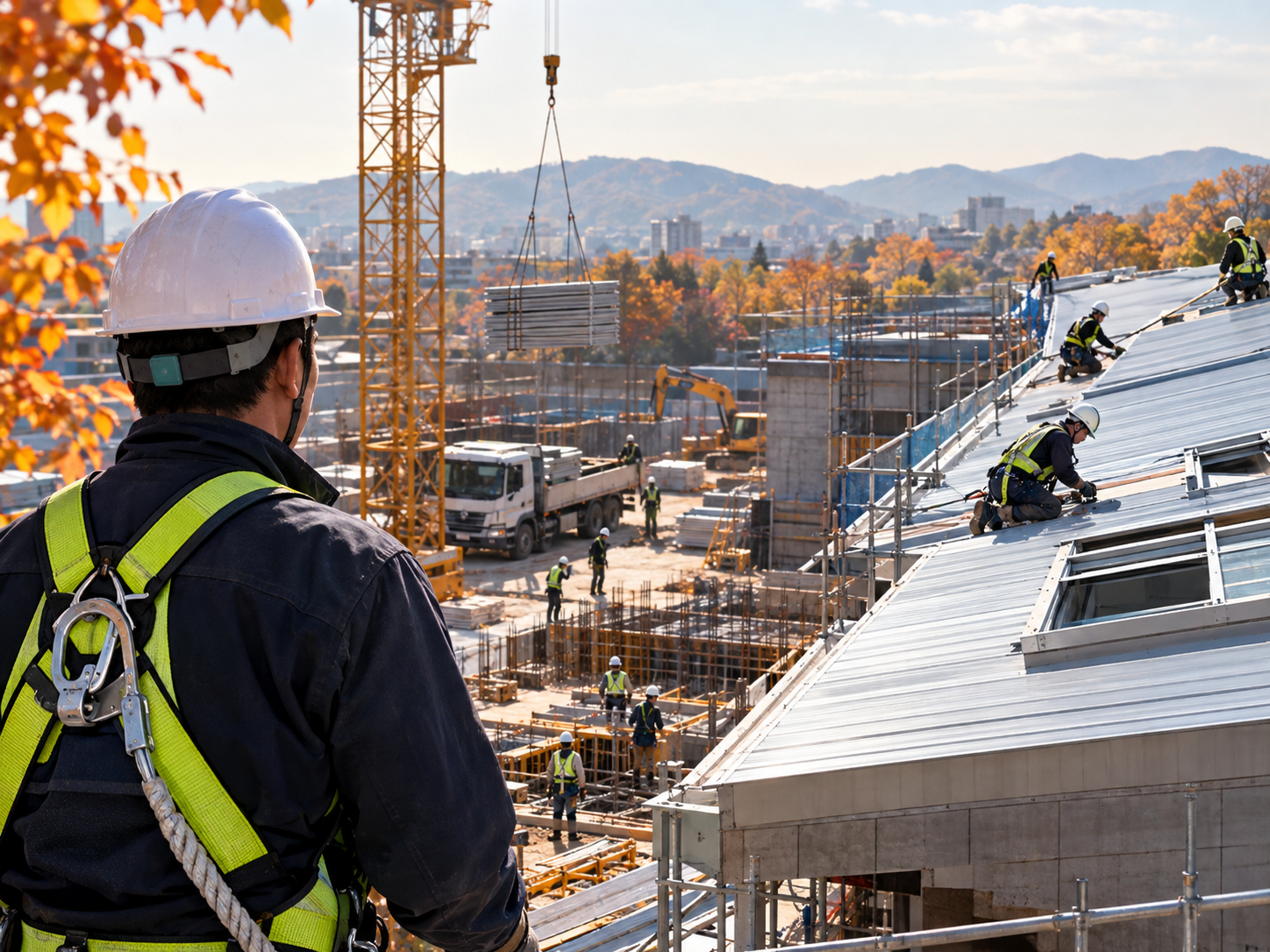
Fall is the season when the most workers are deployed to construction sites, and it is also the season with the highest number of fatalities. Over the past five years, fall had the highest number of fatal accidents at construction sites by season, with 516 deaths—the highest of all four seasons. This is due to the fact that construction projects delayed by summer heat waves and torrential rains are often completed all at once in the fall.
In this news segment, we’ll examine the statistics showing the concentration of accidents in the fall, identify which types of work resulted in the most fatalities, and summarize the causes and countermeasures identified by experts.
According to statistics from the Korea Occupational Safety and Health Agency released on the 7th, over the past five years (2021–2025), the average number of construction workers by season was highest in the fall (September–November), at 2,436,727. This is because construction projects delayed by frequent rain and heat waves in the summer are often rushed to completion in the fall, leading to a concentration of labor during this season.
The problem is that fatal accidents follow the same trend. During the same period, the total number of fatal accidents in the fall was 516, with an annual average of 103.2—the highest among all four seasons.
By type, the primary cause of fatal accidents in the fall is roof work. Over the five-year period, 56 people lost their lives—a figure significantly higher than the 47 in spring, 33 in summer, and 41 in winter. As roof repairs and the replacement of roof panels on factories and warehouses are carried out on a large scale during this period, the investigation found that falls caused by broken skylights and failure to wear safety harnesses occurred frequently.
As the transport of materials and operation of equipment intensified, accidents involving construction machinery and vehicles also peaked in the fall. Truck-related fatalities totaled 30—higher than the 23 in spring, 26 in summer, and 18 in winter—while formwork and shoring-related fatalities also led other seasons with 15 deaths. Fatal accidents involving scaffolding and work platforms (31), ladders (25), and slopes and bedrock (19) were also most frequent in the fall.
To prevent falls during roof work, it is necessary to install sturdy safety covers over skylights and fall protection netting beneath the work area; workers must wear hard hats and safety shoes, and secure their safety harnesses using a lifeline made of Manila rope that is at least 16 mm in diameter.
The statistics indicate that workload is not the only cause. A director at the Korea Construction Industry Research Institute pointed out that as working conditions improve in the fall compared to summer or winter, workers tend to let their guard down, which is another reason for the increase in fatal accidents. He emphasized, “We must thoroughly check compliance with safety rules through TBMs (pre-work safety briefings).”
The government is also keeping a close eye on this period. In response to the increase in roof repairs and solar panel installations during the fall, the Ministry of Employment and Labor is conducting an intensive inspection period for roof and solar panel construction projects from September 28 to October 27. This initiative is driven by the fact that 56 workers have died while performing roof work this fall.
This is where Digital Presso draws attention to a key point. The solution proposed by experts is not new equipment, but rather the TBM itself—and the fact that right now is precisely when TBMs are most likely to be neglected. During peak seasons when labor demand surges, the list of personnel changes every morning, and when combined with the pressure to accelerate the construction schedule, the TBM becomes the first procedure to be treated as a mere formality.
Digitalpresso’s B2B comprehensive construction platform, RenameDP, alleviates the burden of this procedure. Since it provides risk assessments and TBM documentation tailored to the site and handles electronic signatures from attendees right within the app, a record is created immediately that same day detailing which risk factors were shared that morning and who attended. When a spot inspection occurs, there’s no need to prepare separate documents, and even on days with many new personnel, you can easily review what information was conveyed.
Statistics explain why there are so many fatalities in the fall. There are many people on site, equipment is in heavy use, and the weather is good. October and November are the months when these three conditions coincide, and this pattern repeats itself every year.
If a risk is predictable, countermeasures can be planned in advance. Whether the daily morning TBM is actually effective is ultimately the starting point for that planning.
The Korea Economic Daily, “Construction Sites See Increased Workforce After Heat Waves and Monsoon Season… Autumn Safety Accident ‘Alert’,” 2026 — https://www.dnews.co.kr/uhtml/view.jsp?idxno=202610061647026270637
Korea Occupational Safety and Health Agency: Seasonal Statistics on Construction Workers and Fatal Accidents (2021–2025, cited in the article)
The Korea Specialized Construction News, “Ministry of Employment and Labor Launches Intensive Inspection Period for Fall Roofing and Solar Power Construction,” 2026 — https://www.koscaj.com/news/articleView.html?idxno=326704
This content was produced by Digital Presso Co., Ltd. and references the above sources. Please refer to the original text for further details.
