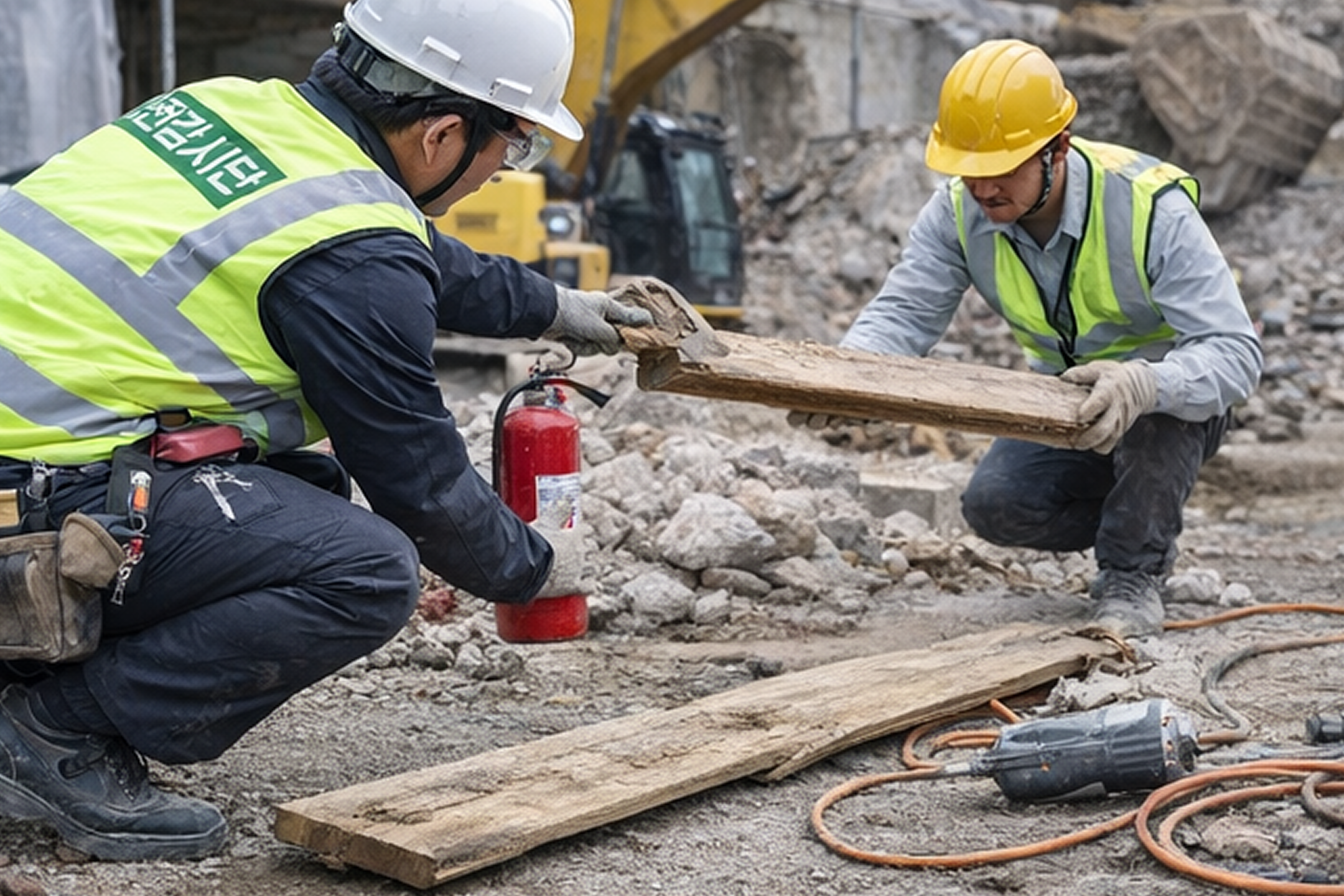
The Korea Land and Housing Corporation (LH) announced that it will begin deploying safety monitoring teams to 25 high-risk construction sites starting in April of this year, and will expand the program to a total of 105 sites starting in June.
The decision to expand the program was based on the results of the six-month pilot program, during which 1,420 hazards were eliminated and zero workplace accidents were reported.
The safety monitoring teams are stationed on-site to prevent unsafe worker behavior, inspect for hazards, conduct safety briefings during TBMs (pre-work safety meetings), and monitor high-risk operations.
In this article, we will summarize the background behind LH’s decision to expand the Safety Monitoring Teams and highlight one structural challenge that this system points to.
The core of LH’s announcement is clear: rather than inspecting hazards after the fact, the company intends to shift its safety management paradigm to a structure where dedicated personnel remain on-site to provide constant monitoring.
LH plans to operate the Safety Monitoring Team by rotating and concentrating 231 members across 105 construction sites.
The agency also stated that it identified high-risk sites through “AI-powered risk analysis based on accident data,” demonstrating that decision-making in safety management is increasingly shifting toward a data-driven approach.
The significance of this trend is clear: there is now a widespread recognition that post-incident inspections alone are insufficient to prevent accidents, to the extent that public contracting authorities are directly deploying personnel.
Since the full implementation of the Serious Accidents Punishment Act, clients and contractors have faced the burden of proving “what measures were actually implemented on-site,” rather than simply reporting the number of inspections conducted. The system, in
which safety monitoring teams identify hazards and take immediate action, is ultimately an attempt to minimize the gap between the occurrence of a hazard and the response to it.
However, the effectiveness of all these activities ultimately depends on “how what happened on-site is documented.”
This reveals a structural challenge: even if the safety monitoring team identifies a hazard and takes corrective action, it is difficult to retain that information as legal evidence required under the Serious Accidents Punishment Act unless it is systematically documented.
Even if a TBM was conducted, it is difficult to prove compliance without signed records, and if communication between the site and the management office is scattered across personal messaging apps, post-incident analysis becomes difficult as well. In a
structure where 231 inspectors are rotated and concentrated across 105 sites, gaps in handover and continuity are likely to occur if site-specific data is not managed in an integrated manner.
This is where Digital Presso comes into play. RenameDP, the comprehensive construction site platform we’ve developed, records site-specific risk assessments and TBMs along with electronic signatures, and automatically logs the entire process—from hazard reporting to response—along with photo metadata (location and time).
In other words, the system ensures that “what risks the monitoring team identified and how they addressed them” is preserved as legal evidence along with the specific time and location of the incident, allowing headquarters and managers to view the same screen simultaneously and make immediate decisions. Automated record-keeping can fill every last gap in human-based monitoring.
If you are a client or contractor preparing to operate a safety monitoring team, we encourage you to consider not only establishing a robust monitoring system but also ensuring that there is a way to document that these monitoring activities were actually carried out.
LH’s expansion of its safety monitoring teams marks a significant turning point, as it signifies that public clients have brought safety management into the realm of direct operation rather than outsourcing. The figures from the pilot program—1,420 risk factors eliminated and zero workplace accidents—demonstrate that having personnel on-site produces clear results.
However, monitoring carried out by human personnel is prone to losing continuity whenever staff are rotated or shifts change. If all activities
of the monitoring team were systematically recorded as data each time, and that data were seamlessly integrated into LH’s “Construction Accident Prediction AI” and “Safe-Point System,” on-site safety management could finally be established as a system where people and data work together.
Korea Specialized Construction – “LH Deploys Safety Monitoring Teams to Construction Sites… to Eradicate Construction Accidents”
This content was produced by Digital Presso Co., Ltd. and references the above material. Please refer to the original article for further details.