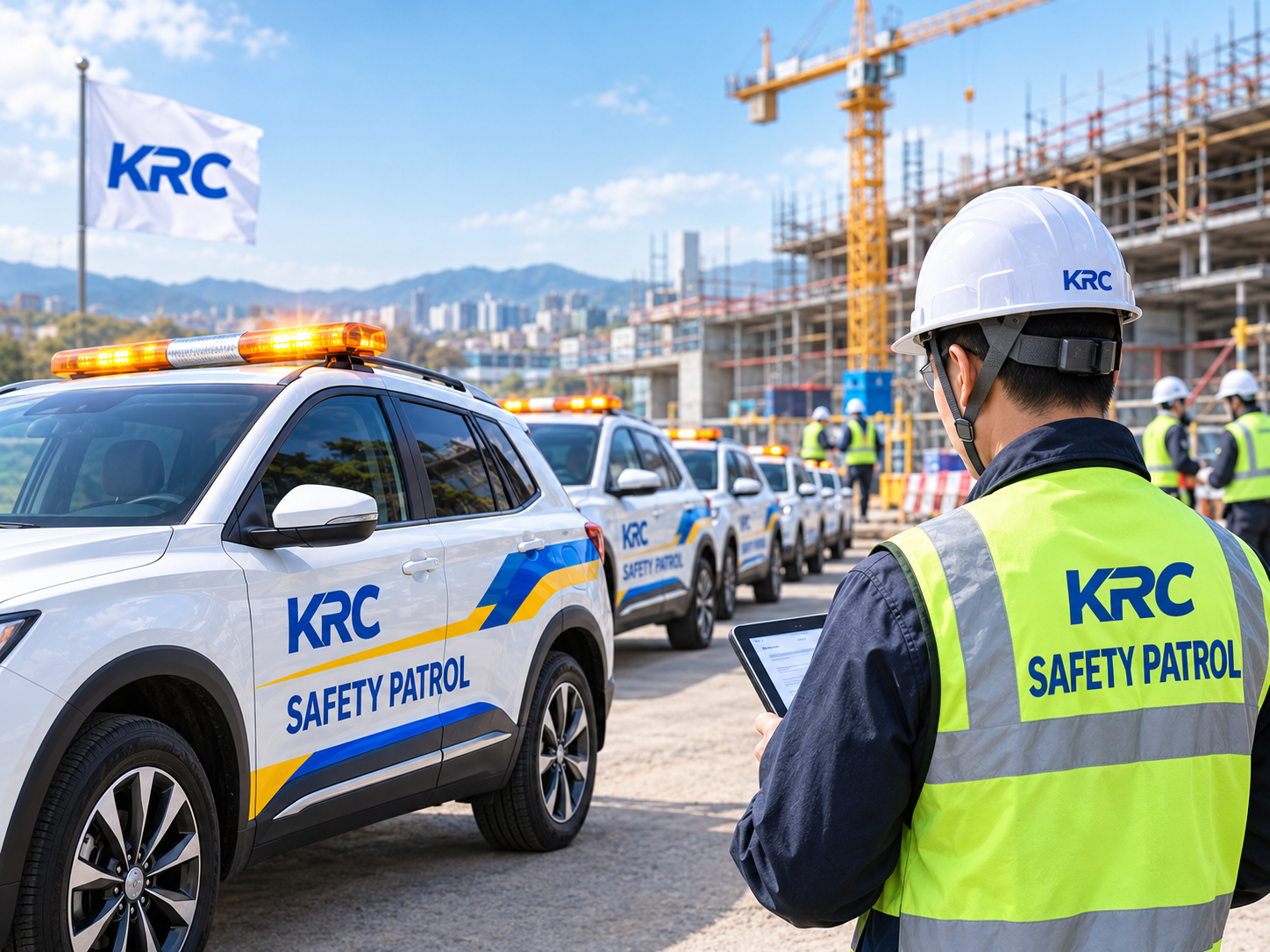
The Korea Rural Community Corporation is expanding its safety patrol vehicle program—which makes unannounced visits to construction sites—nationwide. Following a pilot program last March that deployed one vehicle at its headquarters, the corporation has added one vehicle to each of its eight regional offices, bringing the total fleet to nine vehicles. Noteworthy are the results from the five-month pilot program: a single patrol vehicle resulted in five work stoppages and 20 corrective actions.
In this news segment, we’ll summarize what the KRC safety patrol cars inspect and what conditions the “unannounced” approach requires at construction sites.
Additional Deployment to 8 Regional Headquarters Nationwide
The Korea Rural Community Corporation announced on the 7th that it will deploy additional “KRC Safety Patrol Cars” to eight regional headquarters nationwide. The patrol cars are a means of on-site safety management that visit construction sites without prior notice to check compliance with safety regulations and identify potential hazards. Since deploying one vehicle at its headquarters last March, the Corporation has issued five work stoppages and 20 corrective actions as of August.
With this deployment, the fleet size has increased to nine vehicles, and the Corporation plans to conduct both nationwide unannounced inspections and region-specific intensive inspections. It also announced plans to strengthen its regular patrol system while analyzing the results of patrol car operations to develop measures for improving on-site safety management.
A System That Goes Beyond Merely Issuing Citations
When safety violations or hazards are identified, work is suspended or corrective actions are ordered, followed by a re-inspection to verify that improvements have been made. It is a system where action and verification go hand in hand, rather than ending with a single visit.
Inspection Items
The patrol cars focus primarily on the following “Five Core Safety Rules.”
Conducting a Pre-Work Safety Inspection (TBM)
On-site orientation for new workers before work begins
Prohibit access near construction machinery and assign signalers
Wearing personal protective equipment
Installation of safety and health signs
In addition, we verify compliance with safety measures required for hazardous work types and legal obligations.
Items Verified Visually vs. Items Verified Through Records
If you reread these five items, you’ll notice they differ in nature. While the use of personal protective equipment, the installation of safety and health signs, and the assignment of signalers can be visually confirmed the moment the inspector arrives on site, the pre-work safety inspection (TBM) and on-site verification of new employees are procedures that have already been completed before the inspector arrives. While the first three can be verified simply by observing the site, the latter two raise a different issue: “How will we demonstrate that they were carried out?”
Unprepared Inspections
While scheduled inspections allow for preparation in advance, unannounced inspections do not; therefore, the site must maintain the same condition regardless of when or at what time an inspector arrives. This underscores the requirement that safety management be a daily standard rather than an event tied to a specific date.
Kim In-joong, President of the Korea Rural Community Corporation, stated, “Safety management is meaningful only when it actually works on-site,” and announced that he would inspect construction sites more frequently and address risk factors proactively.
The Coverage Area of Nine Patrol Vehicles
There is also a practical reality to consider here. Since nine patrol vehicles cannot constantly monitor all construction sites nationwide, the effectiveness of unannounced inspections stems not from the number of violations detected, but from the constant vigilance created by the assumption that an inspection could occur at any time. As external inspections increase, the burden on construction sites will ultimately shift toward self-inspections and the documentation of those inspections. The Corporation’s announcement that it will analyze the results of patrol vehicle operations to develop improvement measures is in the same vein; inspections do not end with detection but only become a management system when they are accumulated as data.
This is where DigitalPresso identifies a key point: among the five core safety rules, the very first item is the TBM (pre-work safety briefing). Since this is a procedure repeated every morning, it is prone to becoming a mere formality, and it is difficult to prove compliance afterward.
Digitalpresso’s B2B comprehensive construction platform, RenameDP, resolves this issue through automation. By providing risk assessments and TBM documents tailored to the site and handling electronic signatures from attendees right within the app, it ensures that a record is created immediately that same day detailing which hazards were discussed that morning and who attended. This also means there’s no need to prepare separate documents in the event of an unannounced inspection.
Furthermore, we are enhancing the product with an “AI Site Briefing” feature that, when the app is launched, automatically provides guidance on the day’s work details, key hazards, and precautions, and instantly generates TBM documents. We believe that the more repetitive a procedure is, the more we must reduce the burden of preparation for it to actually work.
The 25 corrective actions logged by a single patrol vehicle over five months represent, when viewed another way, risks that would have gone unnoticed had there been no inspections. It remains to be seen what kind of results this expansion—now involving nine vehicles—will yield.
However, the goal of safety management is not simply to increase the number of violations detected. As inspection results accumulate as data, revealing which types of work and at what specific points in time risks recur—and when that analysis is fed back to the field—the significance of the patrol vehicles also grows. This is why Digital Presso is focusing on the automation of on-site records.
The Korea Specialized Construction News, “Korea Rural Community Corporation Expands Nationwide ‘Unannounced Safety Inspections’ at Construction Sites… Operating 9 Patrol Vehicles,” 2026 — https://www.koscaj.com/news/articleView.html?idxno=326313
Korea Rural Community Corporation (KRC) Announces Expansion of Safety Patrol Car Deployment, September 7, 2026 (cited in the article)
This content was produced by Digital Presso Co., Ltd. and references the above materials. Please refer to the original text for further details.