The day after the Seosomun Overpass collapsed, another worker was buried under a pile of dirt and lost his life at an apartment construction site near Suseo Station in Gangnam-gu, Seoul. The accident was not merely a matter of bad luck but stemmed from a gap in safety procedures—specifically, the "omission of soil retention work," as revealed in post-accident statements. The police have charged the site manager with negligent homicide, and the Ministry of Employment and Labor is reviewing whether to apply the Serious Accidents Punishment Act.
In this edition of Digital Presso’s construction news, we will summarize the facts surrounding the Suseo Station burial accident that occurred on the 27th of this month and the progress of the subsequent investigation, while examining the structural gaps in the on-site safety procedure verification system that this accident has exposed.
Accident Overview
According to reports by Newsis and TV Chosun, a burial accident occurred around 12:44 p.m. on the 27th at an apartment construction site near Suseo Station in Suseo-dong, Gangnam-gu, Seoul. At the site, three workers were excavating to a depth of approximately 3.5 meters to repair aging sewer pipes and were in the process of installing drainage pipes. During the work, a soil wall surrounding the drainage pipe collapsed by about 2 meters, burying the workers under a pile of dirt.
Casualties
Two of the three workers managed to escape on their own, but one man in his 60s was buried. Firefighters who responded found him in cardiac arrest, performed CPR, and transported him to a hospital, but he ultimately died. The accident occurred less than a day after the collapse of the Seosomun Overpass the previous day.
Investigation Launched
Police cordoned off the accident site and began investigating the cause, while the Ministry of Employment and Labor started reviewing whether the Serious Accidents Punishment Act applies to the contractor and the project owner. The Gangnam District Office, which commissioned the project, stated that “on-site safety management is the responsibility of the contractor.”
Site Manager Charged
According to a follow-up report by Newsis on the 28th, the day after the accident, the Suseo Police Station in Seoul booked and questioned Site Manager A on charges of negligent homicide. The key statement was a single sentence. It was determined that during the police investigation, A stated, “We omitted the shoring work because the site was cramped and construction might have been difficult.”
What is soil retention?
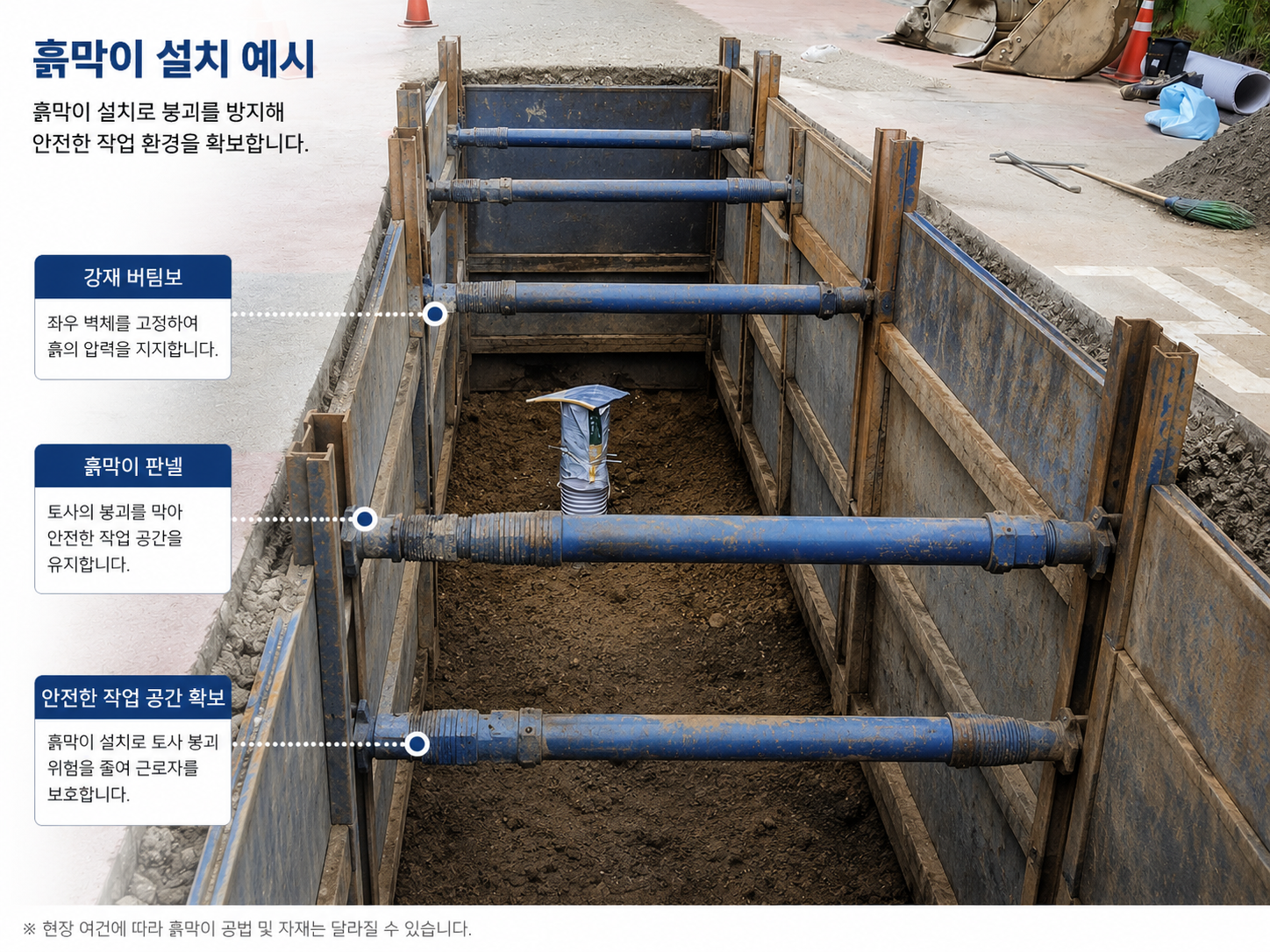
Shore support refers to the installation of structural supports at excavation sites to prevent soil from collapsing or washing away. It is a safety procedure that is virtually mandatory once the excavation depth exceeds a certain level. It is an even more critical process at urban excavation sites with a depth of 3.5 meters, such as the one involved in this accident.
The Time Lag Between the Accident and the Statement
There is a key point to note here. The fact that "the shoring work was omitted" only came to light after one person had lost their life. Prior to the accident, neither the client, the supervising engineer, nor any external parties were aware of this omission in real time.
The fundamental question raised by this accident is not who is responsible, but whether there was a way to verify compliance with safety procedures before the accident occurred.
The current system generally operates as follows: risk assessment reports, TBM (pre-work safety briefing) logs, and work plans are created as paper documents or Hangul files and pass through a single approval chain. After that, there is no external mechanism to verify whether the actual site is being constructed according to the plan. Even if the contractor, supervisor, or client omits part of the procedure citing “limited space on-site,” that fact remains undocumented until an accident occurs.
According to data on industrial accidents from the Ministry of Employment and Labor, the construction industry has consistently accounted for the largest share of industrial accident fatalities each year. Among these, soil collapses and burials are relatively well-known causes, yet they occur repeatedly. This is partly because excavation depths, ground conditions, and work routes vary from site to site, making standardized pre-construction inspections alone insufficient.
Since the Serious Accidents Punishment Act took full effect in 2022, the safety management burden on contractors and project owners has clearly increased due to the possibility of penalties for management officials. However, there are limits to a system that relies on “punishment” to prevent accidents. While there is abundant investigative data to determine who bears responsibility after an accident, there is a lack of data showing whether safety procedures were properly followed before the accident occurred. The fact that the “omission of soil retention measures” in the recent Suseo Station accident was revealed only through post-incident statements clearly illustrates this structure.
This is where Digital Presso focuses its attention: not on whether a risk assessment report was prepared, but on whether data is being recorded to show that the procedures outlined in that assessment are actually being followed on-site.
RenameDP, designed for general construction sites, digitizes risk assessments and TBM procedures to provide site-specific solutions and records compliance via electronic signatures. When construction photos are taken, location and time metadata are automatically mapped, so information on “which process was carried out at which location and when” is accumulated as on-site data rather than post-incident statements. This approach makes it possible to verify whether safety structures—such as retaining walls—that must be secured in advance have actually been installed, not through a single line of approval, but through chronologically stacked photos and records.
Such a record-keeping system cannot prevent every accident. However, it helps shift from a structure where statements like “we omitted it because the site was too narrow” are first heard the day after an accident, to a structure where procedural omissions are revealed at the procedural stage. If your site is grappling with both safety documentation and compliance with the Serious Accidents Punishment Act, I recommend taking a look at this method of automatically accumulating construction records.
The Suseo Station accident, along with the collapse of the Seosomun Overpass, demonstrates that safety management in urban infrastructure construction is once again being put to the test. Regardless of the trend toward broader penalties, accident prevention ultimately boils down to the question of “who verifies that procedures are being followed, and how.” The most pressing lesson from this accident is that the digital transformation of the construction industry must go beyond the automation of approvals and take a step further toward providing proof of compliance.
Newsis, "Burial Accident at Construction Site Near Suseo Station… 3 People, Including One in Cardiac Arrest, Taken to Hospital," May 27, 2026 — https://www.newsis.com/view/NISX20260527_0003645737
TV Chosun, "Burial at Sewo Station Sewer Pipeline Construction Site… Worker in His 60s Dies," May 27, 2026 — https://news.tvchosun.com/site/data/html_dir/2026/05/27/2026052790301.html
Newsis, "Police Charge Site Manager in 'Suseo-dong Burial Death'… 'Retaining Wall Work Omitted'", May 28, 2026 — https://www.newsis.com/view/NISX20260528_0003646967
Kookmin Ilbo, "[Breaking News] Worker Buried at Construction Site Near Suseo Station… Transported in Cardiac Arrest," May 27, 2026 — https://www.kmib.co.kr/article/view.asp?arcid=0029879980&code=61121211&cp=nv
This content was produced by Digital Presso Co., Ltd. and references the above sources. Please refer to the original text for further details.