Ahead of the rainy season, the government is stepping up its efforts to ensure safety at small-scale construction sites with budgets under 5 billion won. The Ministry of Land, Infrastructure and Transport launched safety inspections for the rainy season at approximately 3,000 construction sites nationwide from June 4 to July 31, with about 1,700 of those sites being small-scale projects costing less than 5 billion won. During the same period, the Ministry of Employment and Labor and the Korea Occupational Safety and Health Agency are also launching a specialized support program for small-scale sites, with a budget of 43.3 billion won.
In this article, we will summarize the government’s efforts to strengthen safety management at small-scale construction sites and examine one structural challenge that these initiatives collectively point to.
Table of Contents
What’s Happening: 3,000 Sites Inspected During the Rainy Season, 1,700 of Which Are Small-Scale
Why Now: 68% of Construction Fatalities Occur at Sites Under 5 Billion Won
The Underlying Structural Challenge: The Gap Between Inspections and Actual Implementation
Digital Presso’s Key Takeaways
In Closing
Scale and System of Inspections
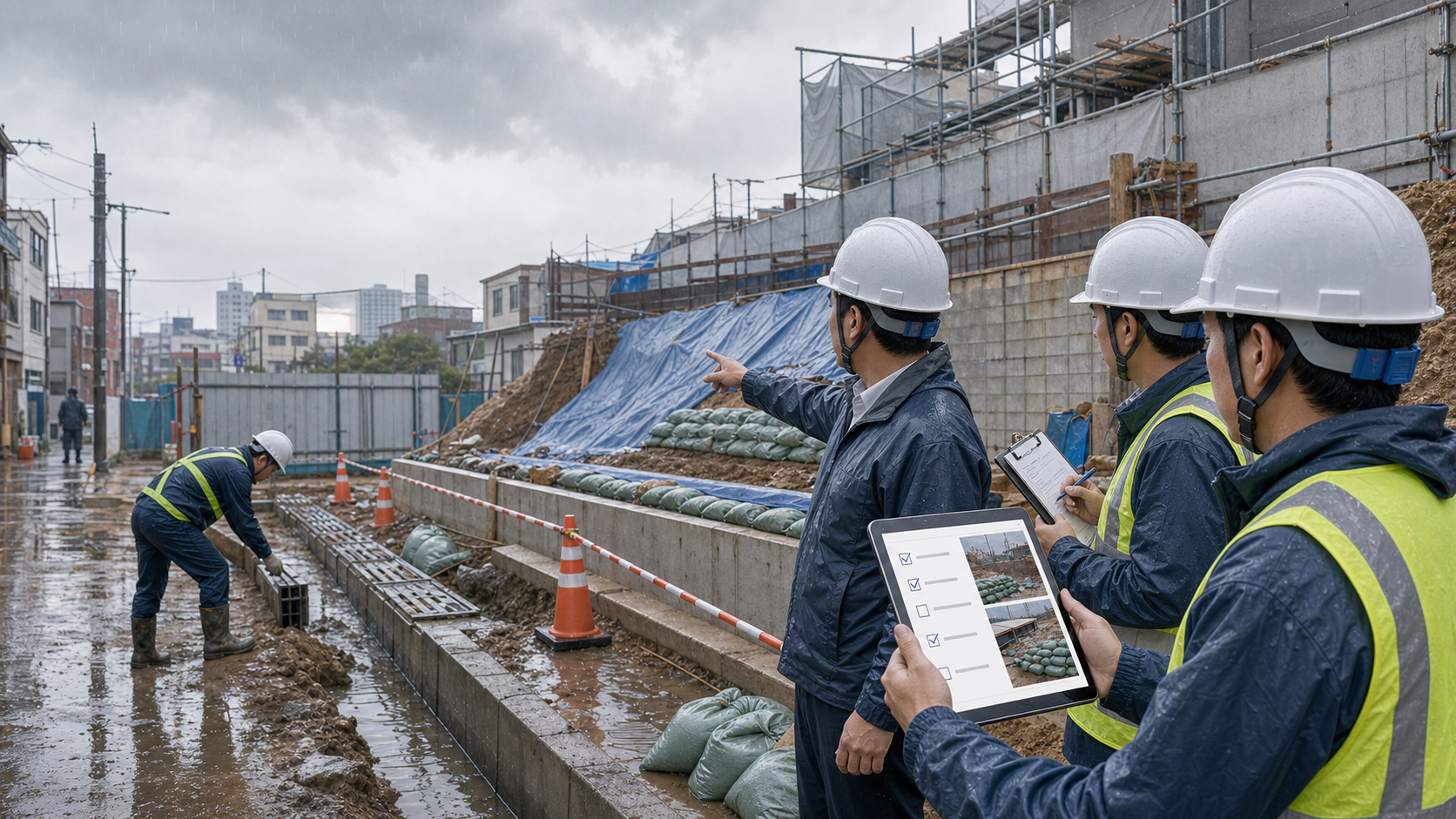
The Ministry of Land, Infrastructure and Transport is deploying approximately 900 personnel from 12 organizations—including regional land offices, public institutions, and private experts—to conduct sequential inspections of about 3,000 construction sites nationwide from June 4 to July 31. Inspection items include slope erosion and ground weakening caused by stormwater infiltration, risks from strong winds, the adequacy of flood control measures, maintenance of drainage systems, and the installation of retaining walls and embankments. Of the approximately 3,000 sites, about 1,700 are small-scale sites costing less than 5 billion won, which will be the focus of this inspection.
Separate support from the Ministry of Employment and Labor and the Korea Occupational Safety and Health Agency
The Ministry of Employment and Labor and the Korea Occupational Safety and Health Agency have also launched simultaneous support initiatives for small-scale sites. They are allocating a budget of 43.3 billion won to the “Small-Scale Specialized Safe Workplace Creation Support Project,” which is being implemented for the first time this year. They will provide up to 30 million won per site to cover costs aimed at reducing the three major types of accidents: falls, entrapments, and collisions. Additionally, a team of 730 "Construction Industry Safe Workplace Guardians" has been established. They patrol the country to identify small-scale sites—such as those undergoing roof repairs or renovations without prior construction notification—and verify the installation of safety facilities and improvements to hazardous work practices.
Overwhelming Proportion of Fatalities at Small-Scale Sites
The statistics clearly explain why the government is focusing on sites with budgets under 5 billion won. According to the Korea Occupational Safety and Health Agency, there have been a total of 1,035 fatal construction accidents over the past three years. Of these, 708 deaths occurred at construction sites with budgets under 5 billion won, accounting for 68.4% of the total. This means that nearly 7 out of every 10 construction-related fatalities occurred at small-scale sites.
Distribution of Fatalities by Project Size
The proportion of fatalities drops sharply as the scale of the project increases. During the same period, 73 deaths (7.1%) occurred at sites valued between 5 billion and 12 billion won, 123 deaths (11.8%) at sites between 12 billion and 80 billion won, and 131 deaths (12.6%) at sites valued at 80 billion won or more. The proportion of fatalities in the under 5 billion won category is more than twice that of the other three categories combined. These figures directly raise the question: why do small-scale sites repeatedly become blind spots in safety management?
Even if the government expands inspections and provides financial support, the question of who will verify and document whether safety measures are actually being implemented on-site remains a separate issue.
During the rainy season, conditions at construction sites change daily. A slope that was stable the previous day may weaken due to overnight rain, drainage channels may become blocked, or the ground around temporary earth retaining structures may collapse. The smaller the site, the more likely it is to lack the personnel needed to record and share these changes in real time.
Under the current system, inspection checklists are often filled out on paper, and site photos are frequently scattered across personal cell phones or messaging apps. Records of installed safety equipment, photos documenting improvements to hazardous operations, and signatures confirming that a pre-work safety meeting (TBM) was held are all stored in different places. Data is often only gathered again after an accident occurs or a supervisor arrives, but by then, some records are missing or the chronological context has been lost.
Ultimately, the key issue is not merely whether an inspection was conducted. It is whether one can prove that “hazards were identified, measures were taken, and those measures are actually being maintained.”
This is where Digital Presso comes in.
The comprehensive construction site platform RenameDP digitizes risk assessments and TBM procedures to suit the specific site, while also recording implementation history alongside electronic signatures. When construction photos are taken, time and location metadata are automatically mapped, allowing data to be accumulated on what safety measures were taken, where, and when. Items for the rainy season inspection—such as drainage maintenance, slope reinforcement, inspection of retaining walls and embankments, and measures against strong winds—are not limited to simple checklists but are recorded along with photos, locations, and times.
As these records accumulate, site managers, head office administrators, clients, and regulatory agencies can all view the history of actions taken on the same screen. The key to safety management at small-scale sites lies not in elaborate systems, but in ensuring that daily risks and the actions taken to address them are not overlooked. Only when a system is in place to ensure that the results of government grants and patrol personnel reaching the site are documented can safety management evolve from a one-time inspection into a sustainable system. If your site is grappling with both safety documentation during the rainy season and compliance with the Serious Accidents Punishment Act, we encourage you to explore a system that automatically accumulates construction records.
Construction sites with budgets under 5 billion won may be small in scale, but they account for the largest share of accident statistics. This is why the government focuses inspection personnel, budgets, and patrol teams on small-scale sites ahead of the rainy season.
However, reducing accidents cannot be achieved simply by increasing the number of inspections. A system is needed that identifies risks on-site, takes corrective action, and records that the measures are being maintained through data. Safety management at small-scale sites must now move from merely saying “we conducted an inspection” to being able to “prove compliance.” Only when safety responses during the rainy season go beyond one-off campaigns and are backed by verifiable on-site data accumulated year after year will we be able to gradually eliminate safety blind spots, starting with the most vulnerable sites.
Ministry of Land, Infrastructure and Transport, “2026 Rainy Season Construction Site Safety Inspection Plan,” 2026
Ministry of Employment and Labor · Korea Occupational Safety and Health Agency, “Guide to the Support Project for Creating Small-Scale Specialized Safe Workplaces,” 2026
Korea Occupational Safety and Health Agency, “Status of Fatal Accidents by Construction Company Size (2023–2025)”
This content was produced by Digital Presso Co., Ltd. and references the above materials. Please refer to the original text for further details.