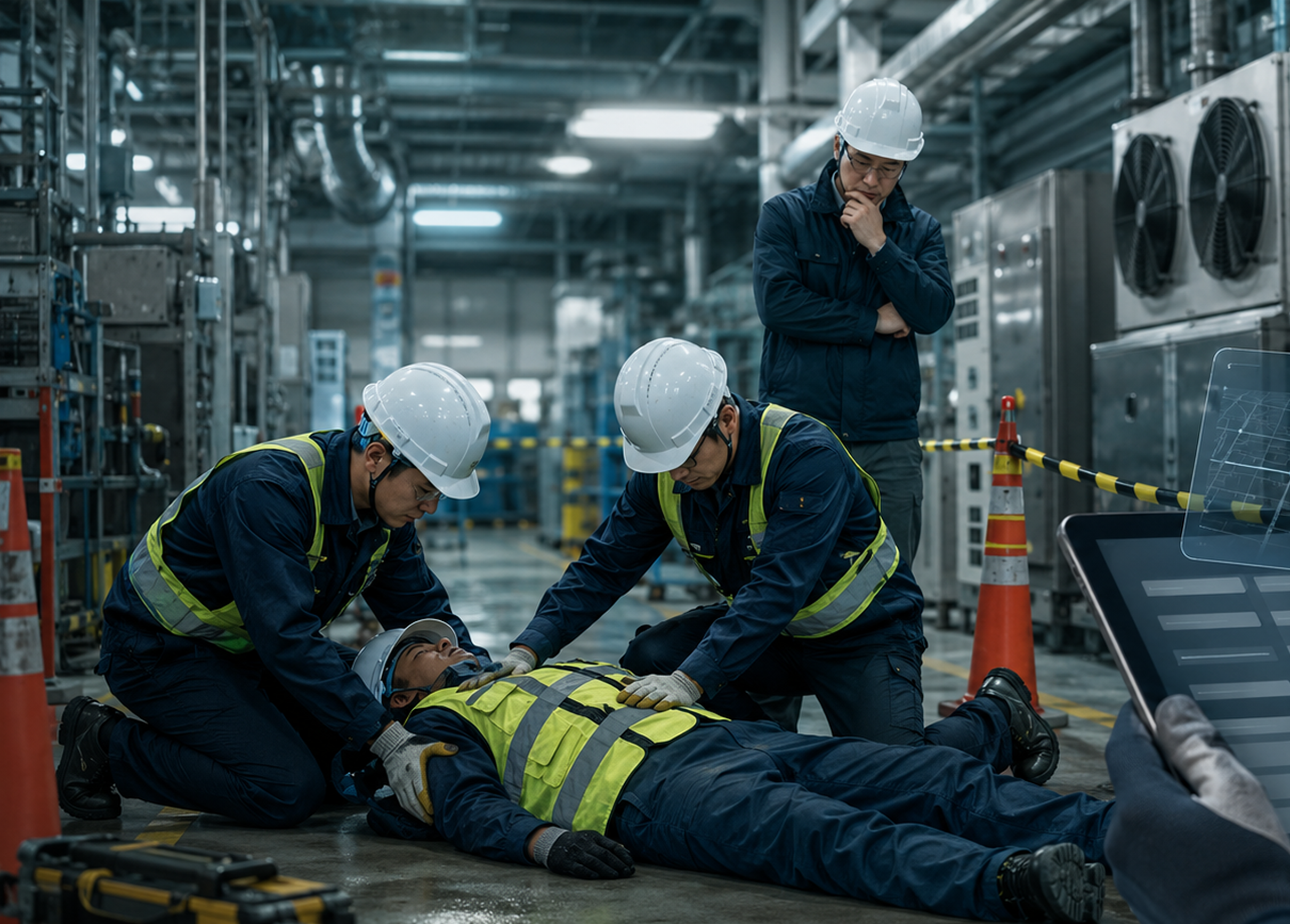
Another fatal workplace accident has been disclosed through corporate filings. According to the Financial Supervisory Service’s electronic disclosure system on July 28, Hanwha disclosed a “serious industrial accident” that occurred at a facility operated by its subsidiary, Ourhome, as a major management matter. At Ourhome’s Eumseong Plant No. 2, a worker from an outside contractor who was performing maintenance on refrigeration equipment was found collapsed during the job and was transported to a hospital, but died en route.
In this article, we will summarize the circumstances of the accident, the recurring patterns of workplace accidents, and the underlying structural challenge of “safety for workers at external contractors.”
What Happened: OurHome’s Disclosure of a Serious Accident at the Eumseong Plant
Recurring Accidents: Third Fatality in Just Over a Year
Key Issue: Safety Blind Spots for External Contractor (Subcontractor) Workers
Structural Challenge: Records and Evidence of Safety Activities Prior to the Accident
Circumstances of the Accident
On the 23rd, a worker employed by an external contractor was found collapsed while performing repair work on a refrigerant leak in the outdoor unit of a chiller at Ourhome’s Eumseong Plant No. 2. He was immediately transported to a hospital but died en route. The cause of death has not yet been determined, and the police and the Ministry of Employment and Labor are investigating the detailed circumstances while inspecting the scene.
Accident Revealed Through Disclosure
Hanwha reported the incident to the Ministry of Employment and Labor the day after it occurred and announced the “occurrence of a serious industrial accident” at its subsidiary, OurHome, via the Financial Supervisory Service’s electronic disclosure system on July 28. However, the disclosure explicitly stated that the accident involved a worker at a subsidiary’s facility, not a Hanwha employee.
What makes this accident particularly distressing is its recurrence. At an OurHome facility in Cheoin-gu, Yongin, Gyeonggi Province, a worker in his 50s died last month after being treated for injuries sustained when his neck became trapped in a conveyor belt; similarly, in April of last year, a worker in his 30s lost his life in a similar entrapment accident. This means that three people have lost their lives at OurHome facilities in just over a year. Based on the results of the Ministry of Employment and Labor’s investigation, it is expected that a determination will be made regarding whether there was a violation of occupational safety and health obligations.
A key point to note is that the victim in this incident was employed by an external contractor, not by OurHome itself. Hanwha also emphasized in its public disclosure that the accident occurred at a subsidiary’s facility and did not involve its own employees.
The safety of workers at contractors and partner companies often falls into an area that is difficult for the prime contractor to control directly. However, the Act on the Punishment of Serious Accidents and recently strengthened occupational safety and health regulations make it clear that prime contractors cannot be exempt from liability simply because control is difficult. In fact, starting in August, construction companies above a certain size will be required to disclose annually the status of fatal accidents involving workers from related contractors (subcontractors). This trend reflects the reality that safety at partner company sites is now the responsibility of the prime contractor and serves as a key evaluation metric.
Whether it’s disclosure or punishment, what these systems have in common is the requirement to be able to consistently provide evidence that safety activities were “carried out.” Particularly at subcontractor sites—which are difficult for the prime contractor to control directly—the key challenge is documenting who identified risks, when, and what measures were taken and when.
At many job sites, risk assessments and safety inspections are still managed in a fragmented manner using checklists, photographs, and verbal instructions. However, when an accident occurs or the disclosure deadline approaches, what is truly needed is not merely a statement that “it was managed,” but records that can substantiate those activities.
This is precisely where Digital Presso is focusing its attention
This is precisely the problem that Digitalpresso is addressing with its construction site platform, RenameDP. By using RenameDP, sites can conduct customized risk assessments and TBMs (pre-work safety briefings) with electronic signatures to document worker participation. Additionally, since photos are automatically tagged with time and location data, there’s no need to scramble to gather evidence of “when and where safety measures were taken” after the fact. By accumulating before-and-after photos alongside AI-generated daily work logs, even the activities of subcontractors—which the prime contractor finds difficult to control directly—are converted into safety management data required for public disclosure and compliance with the Act on the Punishment of Serious Accidents. If you are considering a system to record and document on-site safety activities in real time, we encourage you to take a look.

No system can ever replace a human life. However, in the face of recurring accidents, one thing is clear: verification and documentation before an accident occurs take precedence over the response after it happens. Now that safety is becoming an official metric in corporate evaluations, the importance of routine management—proactively identifying on-site hazards and documenting that process—weighs heavier than ever.
The Korea Economic Daily, “Contract Worker Dies During Maintenance Work at Ourhome’s Eumseong Plant No. 2…Hanwha’s Disclosure on Serious Accidents,” 2026 — https://www.dnews.co.kr/uhtml/view.jsp?idxno=202607282033535000890
Financial Supervisory Service Electronic Disclosure System, Disclosure of Major Management Matters Regarding a Serious Accident at a Hanwha Subsidiary, 2026
This content was produced by Digital Presso Co., Ltd. and references the above materials. Please refer to the original text for further details.