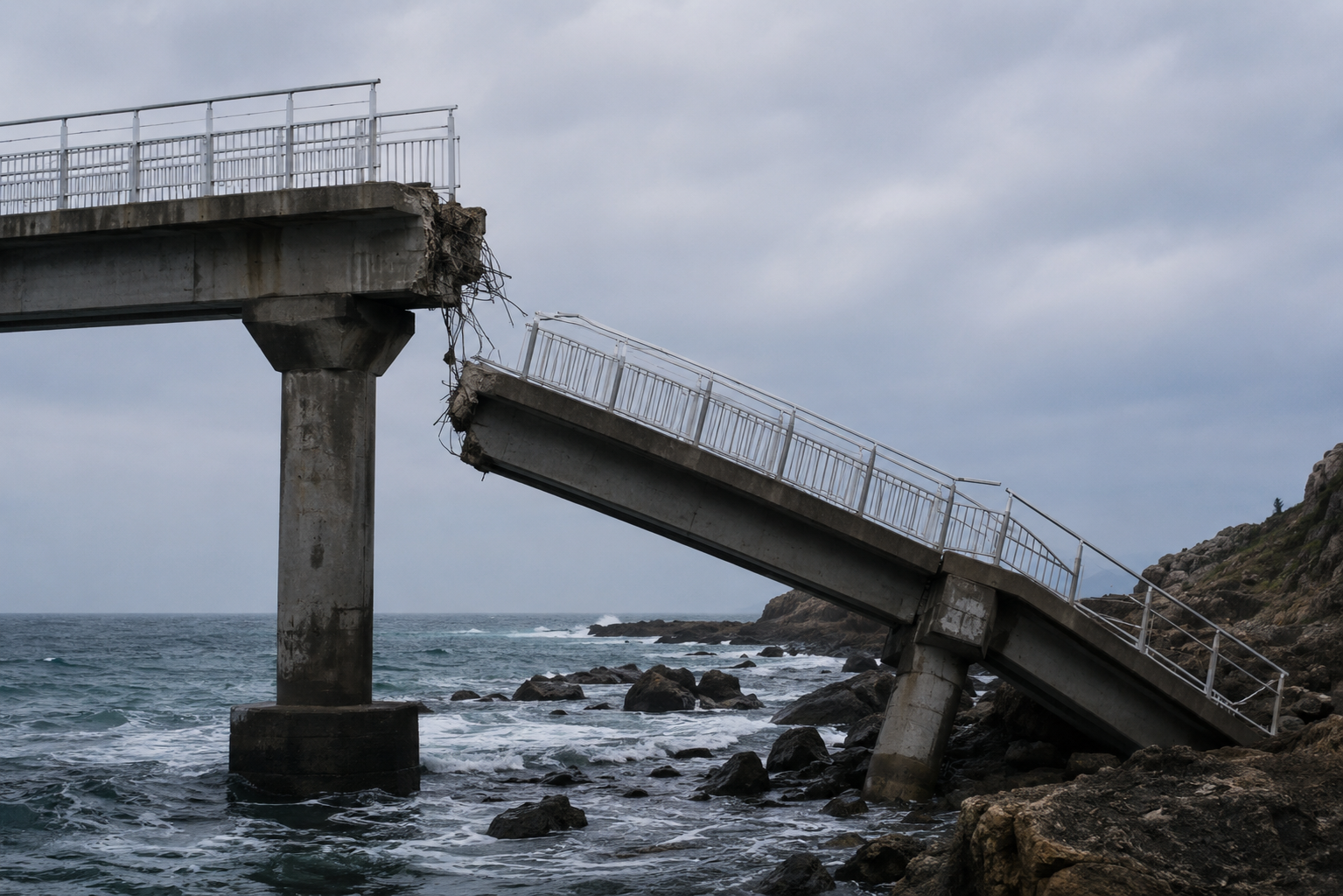
A marine pedestrian bridge that had undergone reinforcement work just over six months ago collapsed. On July 28, the Boridol Bridge in Janggil-ri, Guryongpo-eup, Nam-gu, Pohang, North Gyeongsang Province, collapsed. Fortunately, there were no casualties, and all 17 anglers who had been stranded on the rocky outcrop at the end of the bridge were rescued by fire authorities. The problem is that this bridge was a structure that had undergone reinforcement work just half a year ago.
In this article, we will summarize the facts surrounding the collapse of the Borigdol Bridge and the causes identified by experts, and examine the systemic challenges in safety inspections and construction history management that this accident highlights.
What Happened: A Marine Pedestrian Bridge That Collapsed Just Six Months After Reinforcement
Why Now: The Context of PSC Bridges and Aging Infrastructure
Underlying Structural Challenges: Ratings Exist, but Vulnerabilities Remain Hidden
Points of Focus for Digital Presso
In Closing
Accident Overview
According to the Pohang Southern Police Station and fire authorities on the 29th, the Boritdol Bridge collapsed the previous afternoon. Completed in 2013, the Boritdol Bridge is a marine pedestrian bridge 10 meters high and 225 meters long (with a 170-meter offshore section). It was constructed using the PSC (prestressed concrete) method, in which internal tendons are pulled in advance to apply tension to the concrete.
Grade C and Reinforcement Work
The Boritdol Bridge received a Grade C rating after some defects were identified during a detailed safety inspection in 2024. A Grade C indicates that the facility’s condition is “average,” meaning it can continue to be used with appropriate repairs and reinforcement. Accordingly, Pohang City completed the detailed design the following year and finished the replacement (reinforcement) work this past January. However, the bridge collapsed just over six months later.
A Pohang City official stated that they are investigating the cause of the collapse while keeping all possibilities open. The official explained that no specific issues regarding structural safety were raised during the detailed safety inspection, and the subsequent reinforcement work “focused on surface protection measures such as painting.”
Suspicions Point to Internal Steel Cables
Given that the bridge deck snapped cleanly in half as if it had broken at the time of the accident, attention is focusing on the possibility that there was a problem with the internal steel cables, similar to the past case of the Seosomun Overpass. In particular, the bridge’s coastal location has been repeatedly cited as a factor. Lee Seok-jong, a civil structural engineer, explained that coastal environments create conditions where internal steel cables can corrode more rapidly, and that even without direct contact with water, they can be affected by salt spray carried by sea breezes.
Issues with construction quality have also been raised. Professor Shim Chang-soo of the Department of Infrastructure Systems Engineering at Chung-Ang University pointed out that the steel tendons inside the bridge are constantly subjected to high stress. He analyzed that if the grouting—the process of filling the ducts where the steel tendons are inserted with concrete—or the capping of the anchorage points was inadequate, stress corrosion could have progressed rapidly.
A 13-Year-Old Bridge: Revisiting Design and Construction
The fact that a structure that had been in service for only 13 years collapsed suggests there may have been problems in the initial design, construction, and supervision processes themselves. Professor Jo Won-cheol of Yonsei University’s Department of Civil Engineering emphasized that, given the nature of the collapse, the possibility of illegal activity—beyond mere substandard workmanship—must be considered, and that the entire process, from the initial design through construction and supervision, must be thoroughly reviewed.
A common thread running through the experts’ observations is that the current safety inspection system is unlikely to detect collapses like this one in advance.
Professor Shim Chang-soo pointed out that while the current rating system is useful for indicating the overall condition of a structure, it has limitations in revealing structural vulnerabilities. For PSC bridges, the most accurate method is to drill holes and inspect the interior; however, the reality is that project owners face budgetary constraints and safety inspection firms lack relevant experience. As a result, when abnormalities like those found in the Gangyeon Bridge occur, critical factors that could lead directly to collapse may be obscured by the average value represented by the rating.
Another problem compounds this issue. As seen in this case—where no specific issues were noted during the detailed safety inspection and the reinforcement work focused primarily on painting—the cause can only be traced back if the history of design, construction, supervision, inspection, and maintenance is preserved in chronological order. If the records for each stage are scattered across different documents and responsible parties, the data is often only gathered again after a collapse—by which time the context has frequently been lost. Ultimately, the question must go beyond simply “Was an inspection conducted?” to include “What work was done, when, and how, and is there documentation to support it?”
This is where Digital Presso focuses its attention.
First, it must be made clear that determining the extent of rebar corrosion or the condition of grouting falls within the realm of structural diagnosis and non-destructive testing. No record-keeping platform can replace this function. However, one question that these accidents consistently raise—the recording and tracking of “what was actually done during the design, construction, supervision, and maintenance processes”—is a different matter altogether.
RenameDP, a comprehensive construction site platform, helps document the construction and maintenance processes. When site photos are taken, time and location metadata are automatically mapped, allowing data to be accumulated on what work was performed, where, and when. If a history—such as whether reinforcement work focused on surface coating or extended to anchorage points and internal structures—is preserved alongside photos, location, and time, it provides a basis for reviewing the situation, whether to determine the cause or prevent recurrence.
Such records cannot prevent every collapse. However, a system that keeps the history of construction and maintenance organized in a single, coherent stream clearly demonstrates its value when, after an accident, you need to prove “what was done.” If your site is considering a system to automatically compile construction and maintenance records, we encourage you to take a look.
Although the Boridol Bridge collapse was not large in scale, it succinctly illustrates the challenges facing infrastructure management in Korea. The bridge’s rating was within the normal range, and reinforcement work had been completed, yet it still collapsed. This means that relying solely on ratings—which reflect average conditions—makes it difficult to identify critical factors that, like the case of the steel cable, can lead directly to collapse when abnormalities arise.
Therefore, experts unanimously propose identifying and focusing management efforts on the key factors that directly lead to collapse. If the design, construction, and maintenance histories of each structure are linked and accumulated as data, inspections can evolve beyond one-time rating assessments to a management system that allows for verification over time. With aging infrastructure rapidly increasing, the remaining challenge is to begin this transition starting with the most vulnerable structures.
The Korea Economic Daily, “Collapsed Just Six Months After Reinforcement Work… ‘Urgent Need for Bridge-Specific Safety Assessments’,” 2026 — https://www.dnews.co.kr/uhtml/view.jsp?idxno=202607290821025210900
Pohang Southern Police Station and Pohang Fire Department (cited in the article)
Remarks by Lee Seok-jong, Certified Civil Structural Engineer; Shim Chang-soo, Professor at Chung-Ang University; and Cho Won-cheol, Professor at Yonsei University (quoted in the article)
This content was produced by Digital Presso Co., Ltd. and references the above materials. Please refer to the original text for further details.