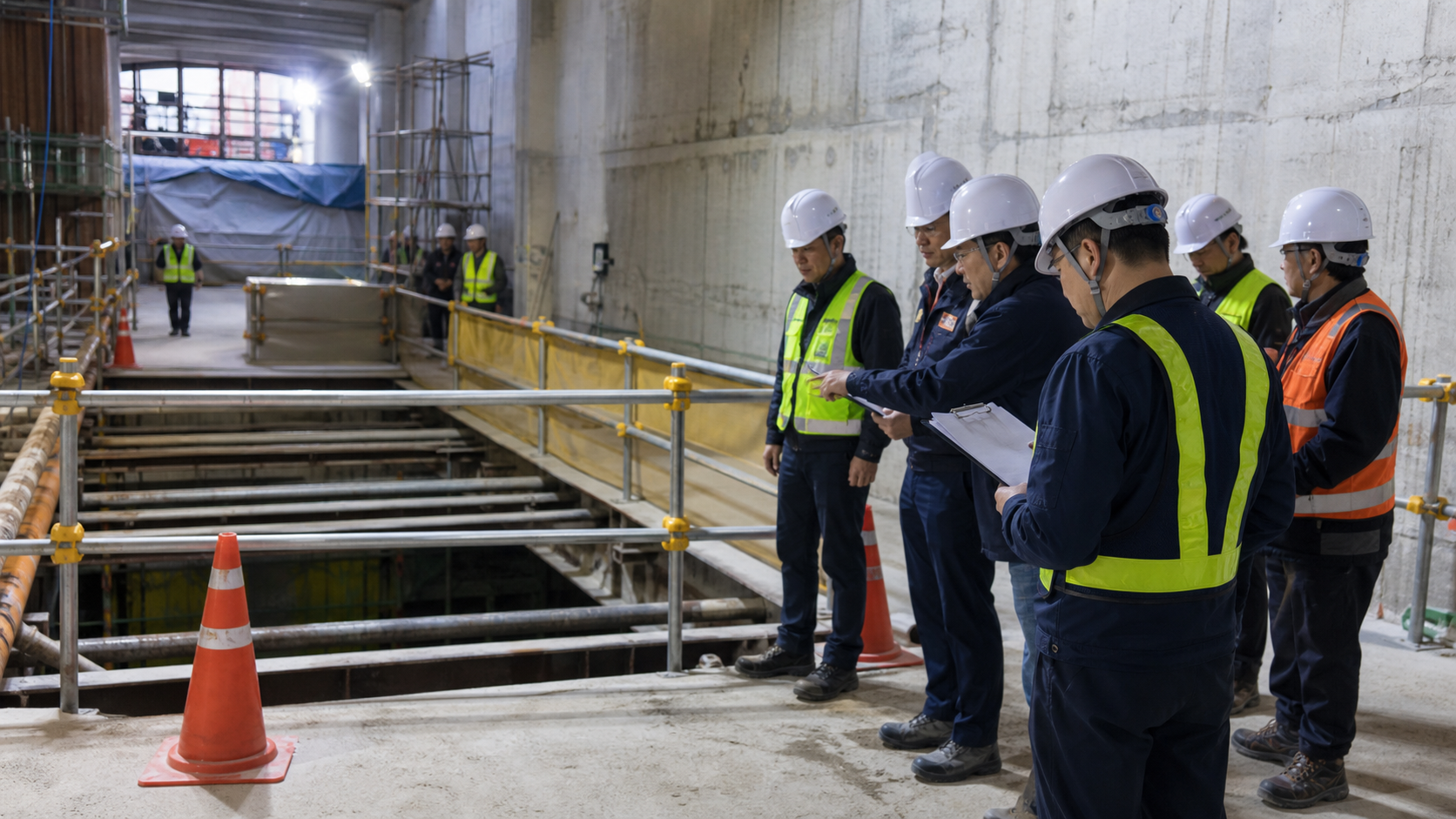
On June 9, 2026, a 35-year-old subcontractor fell 15 meters to his death at the construction site for Section 3-2 of the Shin-Ansan Double-Track Railway in Gwanak-gu, Seoul. The accident occurred while workers were expanding an opening to install cable trays. The problem is that this marks the third fatal accident at a Shinansan Line site operated by the same construction company within eight months.
The Ministry of Employment and Labor immediately ordered a work stoppage, and the Ministry of Land, Infrastructure and Transport launched a special inspection covering all sections of the Shin-Ansan Line as well as other sites operated by the same construction company. In the face of these recurring accidents, the government’s response is also intensifying.
In this article, we will examine why this accident is not an isolated incident, what factors contribute to this pattern of recurrence, and what challenges lie beneath the surface.
What Happened: Three Deaths at the Same Site in Eight Months
Why Now: The Government’s Shift in Response to “Recurrence”
The Underlying Structural Challenges: Why Do Accidents Keep Happening Without Being Properly Documented?
In Closing
Overview of This Accident
According to a report by The Electric Times, the accident occurred around 5:26 p.m. on June 9. A 35-year-old subcontracted worker fell 15 meters to his death while widening an opening to install a cable tray. The Ministry of Employment and Labor immediately ordered a work stoppage at the site and is investigating potential violations of the Occupational Safety and Health Act and the Act on the Punishment of Serious Accidents.
The Weight of It Being the Third
The reason this accident is being taken particularly seriously is that it is not the “first” of its kind. There have already been two fatal accidents at the Shin-Ansan Line construction site, which is being built by the same construction company.
In April 2025, one person was killed and another injured in a collapse of an underground tunnel at Section 5-2 in Iljik-dong, Gwangmyeong-si, Gyeonggi Province.
In December 2025, a rebar bundle collapsed at Section 4-2 of Yeouido Station, killing a concrete pump truck operator.
Collapse, collapse, and fall. Although the types of work and locations differed, the outcome was the same. Within eight months, three workers failed to return home from the job site of a single line operated by a single construction company.
The scope of inspections has changed
A key feature of the government’s response this time is that the scope of inspections is not limited to a single accident site. The Ministry of Land, Infrastructure and Transport has formed an inspection team comprising the Regional Land and Infrastructure Offices, the Korea National Railway, the Korea Land Safety Management Corporation, and external experts to examine the entire Shin-Ansan Line project. In addition, the Ministry has decided to conduct joint inspections with the Ministry of Employment and Labor at seven other sites managed by the same construction company. The inspection items include safety management plans, fall hazard prevention measures, and the current state of construction safety management.
Furthermore, the scope of enforcement has been expanded to include illegal subcontracting and unfair contract practices, and authorities have announced that they will also scrutinize other sites operated by the construction company, focusing on high-risk construction tasks.
"This is unacceptable"
Kim Yoon-deok, Minister of Land, Infrastructure and Transport, stated, "It is unacceptable for construction accidents to occur repeatedly in specific projects or at specific construction companies, and if any violations are uncovered through these inspections, we will hold them strictly accountable." This statement highlights the pattern of "repeated" accidents rather than a single incident as the core issue.
The construction company in question also issued an apology, stating, "We will take all possible measures, including suspending work, until safety is fully ensured."
Not the sum of individual accidents, but a systemic problem
The three accidents occurred during different tasks and involved different tools. Yet the fact that they recurred within the same group of sites suggests this is not a mere accumulation of coincidences but may indicate a problem with the safety management system. The government’s decision to examine not just a single accident site but the entire route and the construction company’s other sites stems from this same recognition.
To break the cycle of repetition, there must be a record of which hazards were identified in advance and what measures were actually taken at each site. However, at many sites, risk assessments and safety inspections are still conducted on paper or verbally, and records are hastily gathered only after an accident occurs. Unless data is maintained showing what was inspected and what was overlooked beforehand, the next site cannot learn from the lessons of the previous one.
This is where Digital Presso comes in
This is where Digitalpresso comes in. Digitalpresso’s construction site platform, RenameDP, provides site-specific risk assessments and TBMs (pre-work safety inspections), and records their completion via electronic signatures, automatically generating the legal evidence required to comply with the Serious Accidents Punishment Act. This system ensures that information about who inspected which risks and when is systematically accumulated rather than scattered.
Combined with real-time site-specific communication and daily AI summaries, the progress of high-risk tasks is shared with managers in real time and organized on a daily basis. Rather than relying solely on human memory and post-incident damage control, this approach focuses on accumulating data on safety activities at the site itself. If you are considering digitizing your safety management system in the face of recurring accidents, please take a look.
The third accident on the New Ansan Line marks not only the death of a worker but also serves as a warning that our construction sites continue to face the same risks repeatedly. Digitalpresso is closely watching to see if the government’s special inspection will go beyond a one-time crackdown and become a catalyst for changing the very way safety records are maintained on-site. Above all, we hope that a workplace where everyone who goes to work returns safely becomes the standard.
The Electric Times, “Another Fatal Accident at Shin-Ansan Line Construction Site… Ministry of Land, Infrastructure and Transport Launches Special Inspection of POSCO E&C,” June 11, 2026 — https://www.electimes.com/news/articleView.html?idxno=369013
Announcement of Special Inspection by the Ministry of Land, Infrastructure and Transport and the Ministry of Employment and Labor (cited in the article)
This content was produced by Digital Presso Co., Ltd. and references the above material. Please refer to the original text for further details.