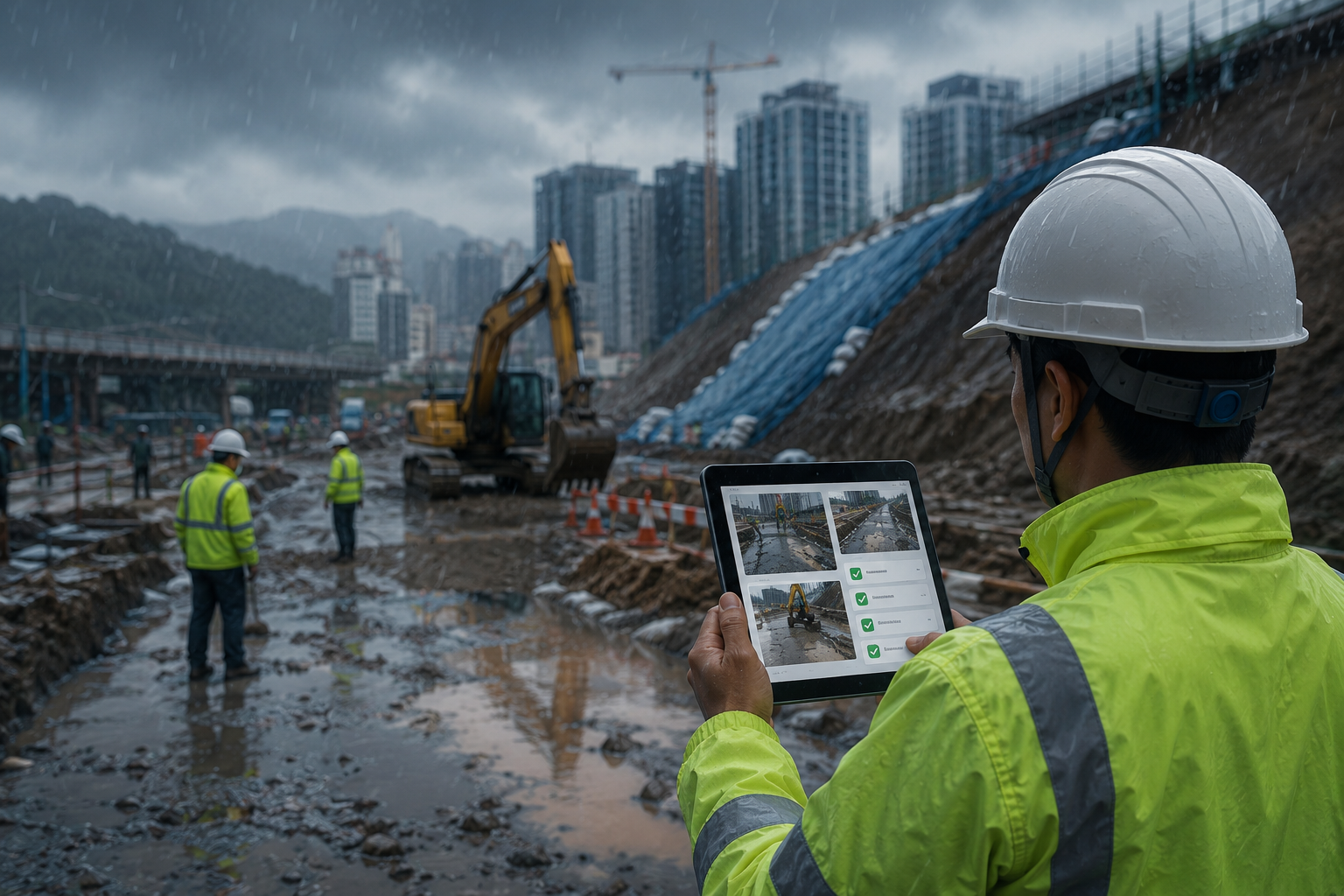
With the rainy season in full swing, safety management at construction sites to prepare for the rainy season is once again becoming a priority. According to a report by The Korea Economic Daily, inspectors from the Korea Land Safety Management Agency visited a construction site for the expansion and renovation of a middle school in Bupyeong-gu, Incheon, on June 16 to conduct a thorough inspection of slopes, drainage channels, excavation areas, and the storage conditions of hazardous materials.
This inspection was not merely a routine site patrol but a process to proactively identify risk factors where heavy rainfall could lead to actual accidents. In particular, during the rainy season, when heavy rainfall is concentrated over a short period, slope collapses, soil erosion, poor drainage, and inadequate management of hazardous materials at construction sites can immediately result in serious accidents.
What Happened: Rainy Season Inspections at Construction Sites Ahead of the Monsoon Season
What Risks Were Identified: Slope, Drainage Channels, and Hazardous Materials Management
Underlying Structural Challenges: How Does Rainy Season Safety Management “Work”?
Inspection of Safety Measures for the Rainy Season
According to an article in The Korea Economic Daily, the Korea Land Safety Management Agency inspected the adequacy of rainy season safety measures at a middle school consolidation, expansion, and renovation construction site in Bupyeong-gu, Incheon. The project was approximately 5% complete and was in the early stages, where excavation and slope management were critical.
Inspectors checked the school building, adjacent slopes, drainage channels, the angle of repose in the excavation areas, and the condition of protective covers. While some sections were assessed as being in good condition—including the securing of tarpaulin covers and sandbags, as well as the construction of drainage ditches—the inspection noted that the slope at the excavation site was steep and that some covers were missing.
Accidents Occur in Sections Scheduled for Repairs
A notable aspect of this inspection was the inspector’s warning regarding the site’s explanation that “we were planning to take action tomorrow.” Since accidents during the rainy season occur without warning, the gap between the time a hazard is identified and the time corrective measures are completed directly increases the likelihood of an accident.
If slope coverings are partially missing, drainage is incomplete, or the angle of repose in the excavation section is too steep, the risk of soil erosion and collapse increases during heavy rainfall. Especially at sites where workers are present, such minor unresolved issues can lead to fatalities.
Hazardous Material Storage Is Also Part of Rainy Season Safety
The management of hazardous materials on-site was also highlighted. Regarding areas where oxygen cylinders and gas cylinders were stored together, inspectors advised that they must be stored separately. This is not merely a matter of organization and tidiness, but a measure to preemptively eliminate risk factors that could exacerbate the scale of damage in the event of an accident.
For rainy season safety inspections to actually work on-site, the results must not end as one-time observations. What matters is that, after a risk factor is identified, a record is kept of who checked it, when, what corrective actions were ordered, and when the issue was actually resolved.
At many sites, rainy season inspections are managed in a fragmented manner—through checklists, photos, verbal instructions, and KakaoTalk messages. However, when an accident occurs after a downpour, what is needed is not just the statement “we inspected it,” but data that can prove the inspection history and the completion of corrective actions.
This is where Digital Presso comes in
Rainy-season safety management ultimately boils down to “ensuring that no hazards identified on-site are overlooked and that they are properly documented.” This is precisely the problem Digitalpresso is addressing with its construction site platform, RenameDP.
Using RenameDP, the time and location information are automatically linked to on-site photos, and key risk factors—such as slopes, drainage channels, and excavation sections—can be recorded on a site-by-site basis. Furthermore, by using TBM, risk assessments, and electronic signatures to maintain a record of worker participation, and by accumulating before-and-after photos along with AI-generated daily work reports, rainy season preparedness activities are transformed from mere reporting into verifiable safety management data.
In safety management during the rainy season, what matters is not the explanation after an accident, but the records before it. When every slope cover, every drainage channel condition, and every hazardous material storage location is immediately recorded on-site and preserved as a history of improvements, safety management for the rainy season can truly be effective.
The message conveyed by this inspection is clear. Safety at construction sites during the rainy season does not begin with special equipment or grand slogans. It starts with the basics: identifying hazardous areas in a timely manner, taking corrective action, and documenting the process.
Accidents during the rainy season may seem to occur suddenly, but in most cases, small warning signs are already present somewhere on the site. Only sites that do not overlook these signs and systematically accumulate them as data can reduce risks during the rainy season.
The Korea Economic Daily, “[Construction Safety A to Z] The Fearsome Rainy Season Is Coming… Ensure Safety with Thorough Rainy Season Preparations!”, June 19,
2026 https://www.dnews.co.kr/uhtml/view.jsp?idxno=202606182158243960960