At this year’s Risk Assessment Best Practices Presentation Contest, 8 of the 16 winning companies—half of the total—were from the construction industry. With not only major construction firms but also regional and specialized construction companies making the list, this is seen as a sign that risk assessment is no longer the exclusive domain of a few large corporations but is expanding its reach across the entire industry.
In this article, we will summarize the results of the competition, the approaches demonstrated by the winning sites, and the underlying structural challenges that remain.
What’s Happening: 8 Construction Firms Among 16 Winners
What Approaches Were Recognized: Participatory Assessments Led by Construction Sites
Underlying Structural Challenges: How Does Risk Assessment “Work”?
Overview of the Presentation Contest
On the 7th, the Ministry of Employment and Labor and the Korea Occupational Safety and Health Agency (KOSHA) held the “2026 Risk Assessment Best Practices Presentation Contest” and presented awards to the 16 workplaces that advanced to the finals. This is the result of a four-stage screening process—including regional presentation contests in seven regions, preliminary screening for the finals, and on-site evaluations—from among the 545 workplaces that applied this year (363 in manufacturing and other sectors, 182 in construction).
Joint Awards for Large Corporations and Specialized Construction Firms
Notably, 8 of the 16 winning companies—half of the total—were in the construction industry. In the construction sector, four major construction firms—Doosan Construction, Ssangyong Construction, HS Hwaseong, and Zai C&A—were joined on the list by four specialized construction firms: Geumyang Green Power, Sehong Power, Hanyang E&G, and Hyundai Muvecs. The message of this competition—“Safety is not just the responsibility of large corporations”—was clearly reflected in the list of winners.
Large Companies’ Rotational and Special Management Systems
Doosan Construction established a PDCA cycle at the “Siheung Power Line Construction” site by combining ad hoc evaluations by the client and prime contractor with ongoing evaluations by subcontractors. The company was recognized for directly incorporating the experience of veteran workers into the identification of risk factors, following a resolution by the labor-management consultative body. Ssangyong Construction introduced an “S-Grade System,” which involves selecting 12 high-risk tasks for special management subject to headquarters approval, and ensured that foreign workers could participate in evaluations by providing dedicated interpreters and AI translation apps.
Site-Centric Approaches by Small and Medium-Sized and Specialized Construction Firms
The achievements of small and medium-sized construction companies were also notable. Sehong Electric developed and utilized 30 types of Job Safety Analyses (JSAs) tailored to the ever-changing nature of overhead power distribution work, while Hanyang E&C implemented a participatory risk assessment by encouraging workers to directly map out the hazards they personally experienced in their work environment. Regardless of company size, the common thread is that they enabled workers to identify risks “on-site, by themselves.”
The questions raised by these award-winning cases ultimately converge on one point: What is needed for risk assessments to actually function on-site, rather than remaining a mere procedural formality?
Ryu Hyun-cheol, Director General of the Occupational Safety and Health Bureau at the Ministry of Employment and Labor, emphasized, “For risk assessments to function properly on-site, it is crucial to expand worker participation and to identify and address not only managed risks but also actual, existing risks.” Put another way, this is precisely why risk assessments in many workplaces remain nothing more than formal documents. Unless there is a process for recording the risks workers actually experience—which vary daily—and for those records to lead to improvements and serve as evidence, the assessment remains nothing more than a document in a filing cabinet.
This is the point where Digital Presso focuses its attention.
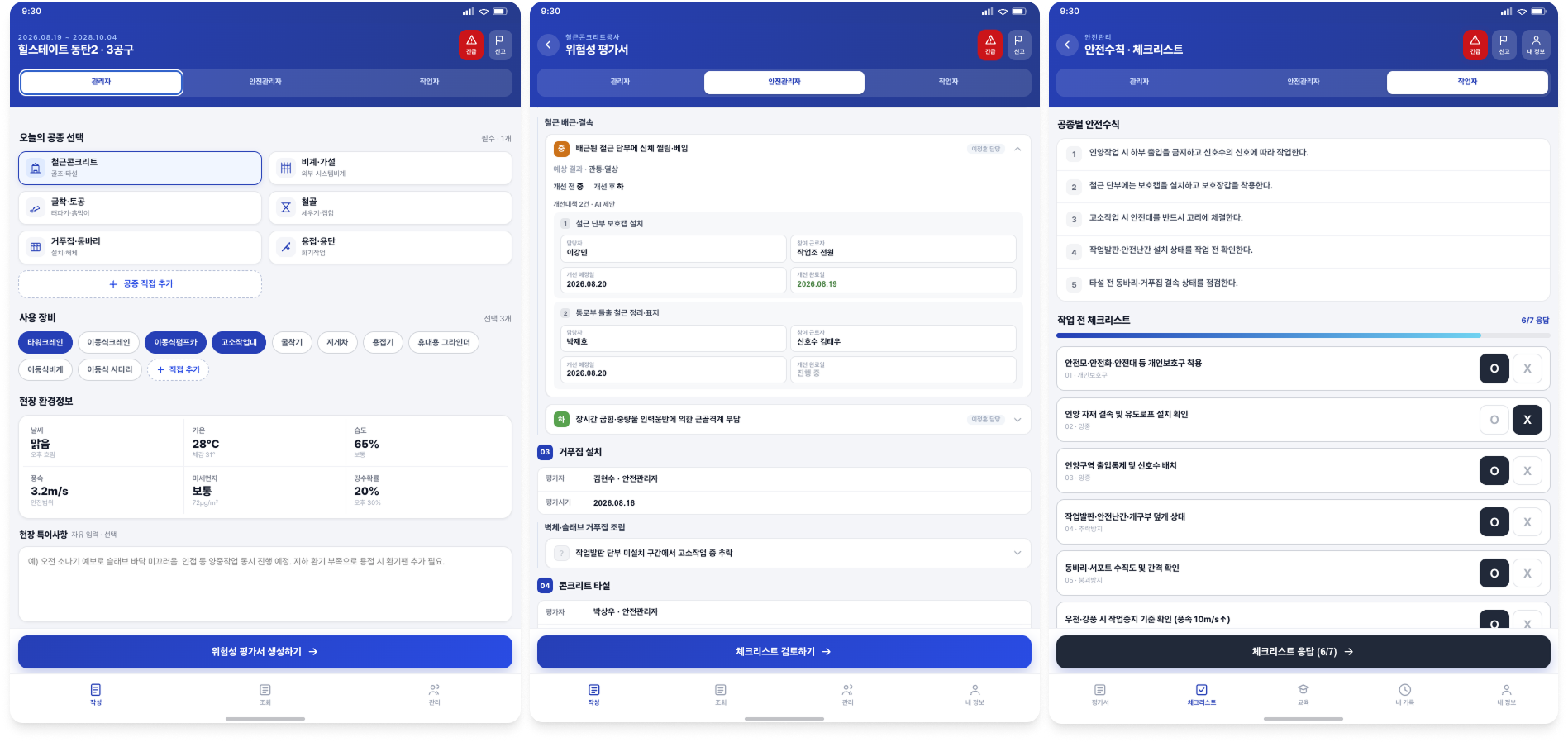
What the award-winning sites had in common was “identifying risks in real time on-site and documenting them.” This is precisely the problem Digitalpresso is addressing with its construction site platform, RenameDP. RenameDP provides site-specific risk assessments and TBMs (pre-work safety briefings), and uses electronic signatures to record workers’ participation history, accumulating this as legal evidence to comply with the Serious Accidents Punishment Act. When location and time metadata are automatically mapped to on-site photos and AI-generated daily work reports are created, the actual hazards present at the site today—along with the measures taken—are preserved as data without being lost.
For sites just beginning to systematize their risk assessments, I recommend exploring how to integrate worker participation, documentation, and evidence into a single, seamless process.
The significance of this awards ceremony lies not in the awards won by specific companies, but in the trend of safety management expanding from large corporations to regional and specialized construction firms. As risk assessments become part of the everyday language on job sites, the gap between managed risks and actual risks will narrow. If site participation and the digitization of records go hand in hand in closing that gap, the foundation of our safety culture is expected to become even stronger.
The Korea Economic Daily, “8 Construction Firms Among 16 Outstanding Risk Assessment Cases…Regional and Specialized Construction Firms Making Strides,” 2026 — https://www.dnews.co.kr/uhtml/view.jsp?idxno=202607071543466190294
Ministry of Employment and Labor · Korea Occupational Safety and Health Agency, “2026 Risk Assessment Best Practices Presentation Contest” (cited in the article)
This content was produced by Digital Presso Co., Ltd. and references the above material. Please refer to the original text for further details.