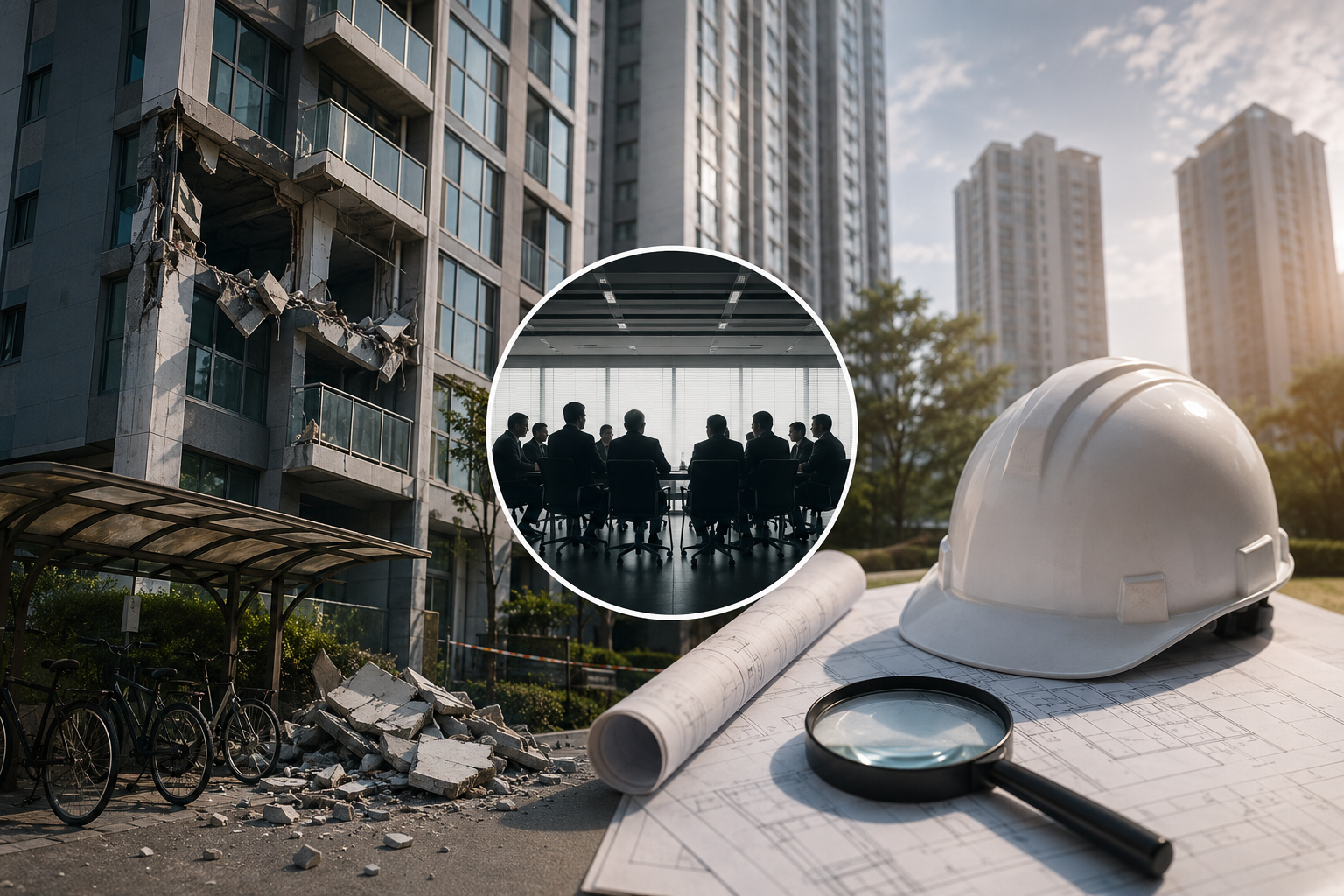
A balcony collapsed at a newly built apartment complex that had been completed only a year and a half ago. The incident occurred in Songdo, Incheon, on the 7th. Although there were no injuries, residents’ anxiety has not easily subsided because the balcony fell next to a bicycle storage area frequently used by children. About two weeks later, on the 20th, Incheon City and the Ministry of Land, Infrastructure and Transport jointly formed a “Facility Accident Investigation Committee,” and a three-month investigation began on the 21st.
In this article, we’ll summarize the details of the Accident Investigation Committee’s formation, the reasons why residents remain anxious, and the structural questions this accident raises for construction sites.
What Happened: Incheon City and Ministry of Land, Infrastructure and Transport Joint Accident Investigation Committee to Conduct 3-Month Investigation
Why Residents Find It Hard to Trust the Contractor’s Inspection
Why Was the Formation of the Investigation Committee Delayed?
The Underlying Challenge: When Identifying the Cause Becomes “Uncovering” Rather Than “Inquiring”
What Digital Presso Is Focusing On at This Point
In Closing
Source
10 members; investigation to run through November 20
According to Incheon City on the 20th, the city has formed a “Facility Accident Investigation Committee” jointly with the Ministry of Land, Infrastructure and Transport and will begin a full-scale investigation starting on the 21st. The committee consists of 10 experts in various fields, including architectural structures, construction, and law. Professor Hong Geon-ho of Hoseo University (President of the Korean Concrete Society) will serve as chair.
The investigation will last three months, through November 20. During this period, the committee plans to conduct on-site investigations, analyze the cause of the structural collapse, and develop measures to prevent a recurrence.
Accident Overview
The accident occurred on the 7th. At a newly built apartment complex in Songdo—which had been completed about a year and a half ago—balconies and exterior cladding fell. Although the contractor, SK Eco Plant, announced a separate safety inspection plan, residents have been demanding a government-led investigation into the cause and safety inspections, separate from the contractor’s efforts.
An Incident at an Apartment That Passed All Verification Procedures
The residents have clear grounds for saying they find it difficult to trust the results of the contractor-led inspection. This is because the apartment complex underwent both a safety assessment and supervision prior to occupancy. If an accident occurred in a building that had passed the verification procedures required by the system, the natural question arises: how should residents accept the results of another inspection conducted by the same entity?
An official from the residents’ emergency response committee reported that there were concerns the formation of the investigation committee was somewhat delayed compared to recent incidents involving the collapse of similar structures. The fact that the structure fell right next to the path frequently used by children—in a complex with many households with young children—is another factor fueling anxiety.
Anxiety Spills Over into the Market
The fallout extended beyond safety concerns. The Emergency Response Committee official stated that, regardless of the safety inspections, “there has been a string of lease and sales contract cancellations,” exacerbating the confusion. With suspicions even being raised that another balcony near the accident site appears partially tilted to the naked eye, concerns are mounting about the overall shoddy quality of the post-construction separate pouring method used on the already collapsed balcony. It is reported that some residents are even demanding refunds of their pre-sale payments or the demolition and reconstruction of the building.
Urgency from the National Assembly and Explanations from the Ministry of Land, Infrastructure and Transport
There was a gap of about two weeks between the date of the accident and the formation of the investigation committee. The National Assembly also pointed this out. On the 19th, during a plenary session of the National Assembly’s Land, Infrastructure, and Transport Committee to review the budget settlement, Representative Jeong Il-young of the Democratic Party of Korea urged the Minister of Land, Infrastructure, and Transport to swiftly form an investigation committee led by the ministry and conduct a thorough investigation.
MOLIT maintains that the delay was due to the time required for inter-agency coordination and careful selection of committee members. An MOLIT official explained that they had to meticulously review grounds for recusal “during the process of selecting committee members independent of the construction company’s interests.” This is a dilemma that accident investigation systems consistently face: the conflict between ensuring the independence of the investigation and starting the investigation quickly.
Apology from the Construction Company
The construction company also issued an official statement. Kim Young-sik, President of SK Eco Plant, stated on the 18th via the company’s website that, as the company’s chief executive, he “sincerely apologizes.” Along with the apology, he promised safety inspections by external expert agencies, as well as support and compensation commensurate with the damage and inconvenience suffered by residents.
Why Does It Take Three Months?
There is one point worth noting. The reason it takes 10 experts three months is not merely because the accident itself is complex. It is because there is no readily available data showing the exact sequence, timing, and methods of construction that took place at that location a year and a half ago. In effect, determining the cause becomes a process of “unearthing” facts rather than simply reviewing records.
The “staggered pouring” method mentioned in connection with this accident involves pouring the structural elements in stages rather than all at once. With this type of construction method, “process conditions”—such as joint treatment, pouring timing, and curing conditions—are crucial to determining quality. Yet, the process itself vanishes upon project completion, leaving only the final result. Of course, it is now up to the Special Investigation Committee to uncover the actual cause, and at this stage, we cannot definitively pinpoint a specific construction method or contractor as the cause.
Inspection Is a “Point,” Construction Is a “Line”
Safety inspections and construction supervision are “point” verifications that check specific moments in time. In contrast, construction is a “line” that extends over several months. The fact that accidents occur in buildings that have passed inspections is not unrelated to the reality that the processes between these “points” are overlooked without being documented. Residents’ distrust ultimately stems from this as well. Since there are no verifiable records, all that remains are mutual claims and speculation.
Digital Presso focuses on a specific aspect here: it is not the investigative capabilities after an accident, but rather the form in which the construction process prior to the accident is documented that ultimately determines the speed of identifying the cause and restoring trust.
Digitalpresso’s B2B comprehensive construction platform, RenameDP, addresses this issue by focusing on the structure of record-keeping. When photos are taken on-site, location and time metadata are automatically mapped, and names are generated by category. As a result, information about which building, which location, and what work was performed—and when—is accumulated without the need for separate organization. In addition, AI automatically generates daily work logs, preserving a record of the site’s daily activities in a format that can be easily reviewed later. This structure reduces the burden of manual documentation while simultaneously securing evidence of construction quality.
Furthermore, Digitalpresso is advancing its product beyond simple documentation to assist with on-site decision-making. Examples of this include the drawing-based Copilot, which instantly matches a selected location on a drawing with relevant construction methods, past case studies, and applicable regulations, and the Site Diagnosis Copilot, which analyzes photos, drawing locations, and voice queries together to identify risk factors and areas requiring verification. While the final decision still rests with on-site experts, the goal is to enable them to access the evidence needed for that decision right on the spot.
If you are considering redesigning your on-site documentation system, start by examining which data structures remain intact even after project completion.
The Accident Investigation Committee’s conclusions will be released after November 20. Another key point to watch in this investigation is whether the results will go beyond merely determining responsibility at individual sites and lead to institutional discussions on how the construction process should be documented and preserved.
Above all, I hope that for the residents who are living in fear even at this very moment, these three months will yield a satisfactory answer.
The Korea Economic Daily, "''Balcony Collapse' at Incheon Songdo Apartment… Incheon City and Ministry of Land, Infrastructure and Transport Form Investigation Committee,” 2026 — https://www.dnews.co.kr/uhtml/view.jsp?idxno=202608200942112480631
Incheon Metropolitan City and Ministry of Land, Infrastructure and Transport Announce Formation of Facility Accident Investigation Committee (cited in article)
National Assembly Land, Infrastructure, and Transport Committee Plenary Session on the Settlement of Accounts, August 19, 2026 (cited in the article)
Apology Statement by the CEO of SK Eco Plant, August 18, 2026 (cited in the article)
This content was produced by Digital Presso Co., Ltd. and references the materials listed above. Please refer to the original text for further details.