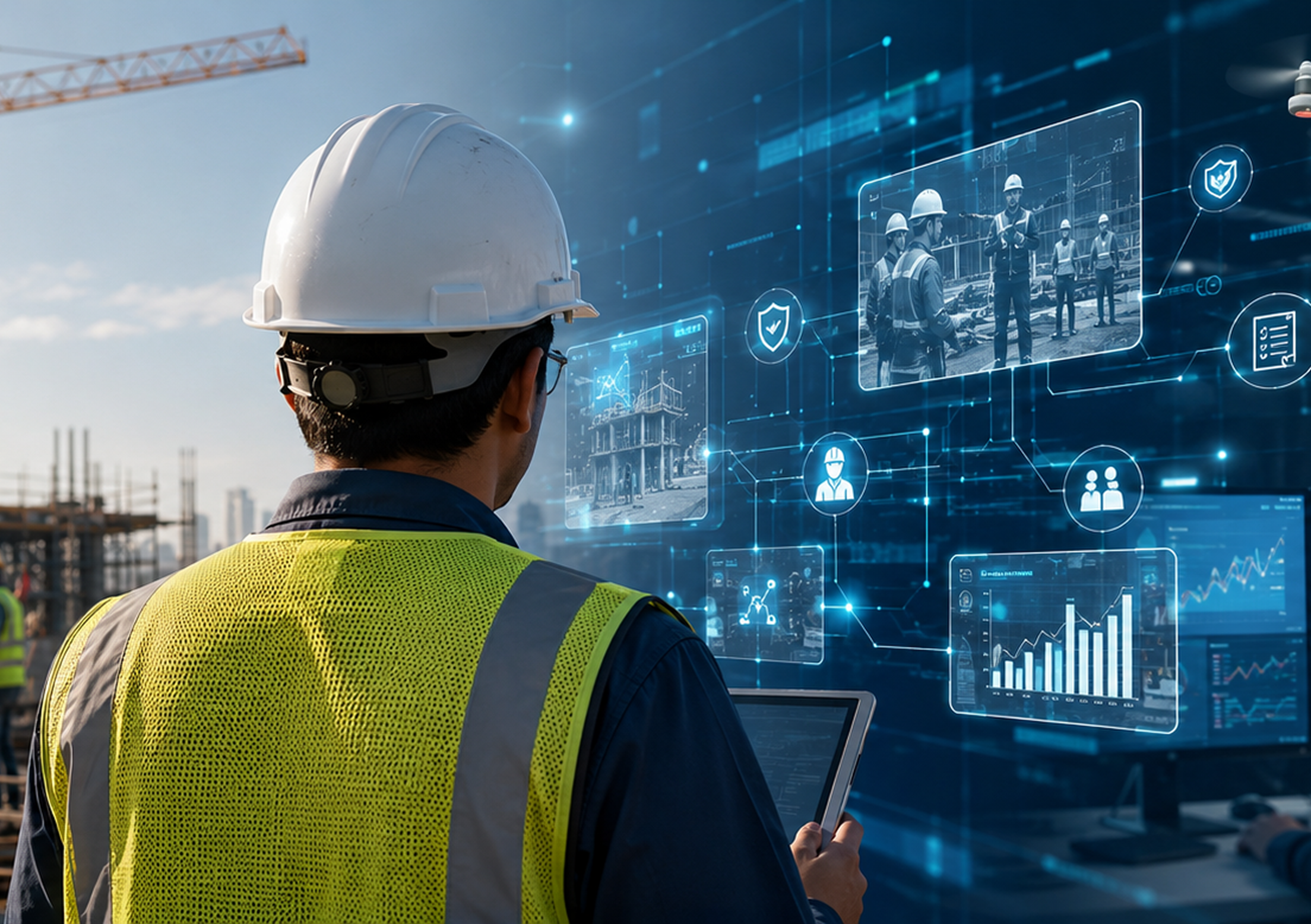
Construction companies’ safety strategies have changed noticeably over the past year. While last year’s sustainability reports focused on introducing individual technologies such as AI cameras,drones, translation apps, and smart helmets, this year has seen a clear shift toward describing these technologies as part of an “operational framework” linked to the right to halt work, subcontractor evaluations, training, and incentives. These strategies are evolving beyond the simple provision of equipment to structures that actually change the behavior of on-site workers and subcontractors.
In this article, we will summarize the changes in safety management revealed in the sustainability reports of major construction companies, as well as the underlying structural challenges.
What’s Happening: From “Equipment Introduction” to “Operational Framework”
Approaches Demonstrated by Five Construction Companies
Underlying Structural Challenges: Construction Sites Not Connected by Data
The Shift in Narrative Focus
A common feature of this year’s reports is that they describe technology not in terms of “what was purchased,” but rather “how it is operated.” As AI, IoT, and translation apps are integrated with worker behaviors—such as exercising the right to stop work, reporting hazards, and attending TBMs (pre-work safety briefings)—safety management has effectively shifted from being an issue of equipment to one of data and systems. Major companies are institutionalizing this trend through platforms they’ve each branded with their own names.
Turning the Right to Stop Work into a “Culture”: Samsung C&T
Since becoming the first domestic construction company to fully guarantee the right to stop work in 2021, Samsung C&T’s Construction Division recorded a cumulative total of 654,957 instances by the end of last year, with 167,582 of those occurring in 2022 alone. To encourage its use, the company rewards best practices and even operates a system to compensate partner companies for losses incurred due to work stoppages. The cumulative number of participants who have completed the hands-on Safety Academy program, including those from partner companies, has reached 73,914.
Rewarding Behavior: Hyundai Engineering & Construction
Hyundai Engineering & Construction’s “H-Safety Wallet” has established itself as a platform that incentivizes worker behaviors such as accident-free certification, TBM attendance, and hazard reporting. The cumulative payout has increased from 5.4 billion won in last year’s report to approximately 7.9 billion won this year. For partner companies, the company has implemented measures such as a 50% reduction in contract performance deposits, thereby tightly weaving together a “inspection-reward-prevention” system.
Overcoming Language Barriers with Data: GS Engineering & Construction
GS Construction, which employs a high proportion of foreign workers, has expanded the language support for Xi Voice from 120 to 137 languages, with approximately 20,000 people using it daily for safety checks and training. In this year’s report, the company disclosed figures showing 4,225 work stoppage requests and a 99.2% completion rate for corrective actions, demonstrating an operational workflow that spans from hazard detection to corrective measures.
Centralized Monitoring at Headquarters: DL E&C
DL E&C established a three-tier monitoring system that connects control room personnel at headquarters, job sites, and remote locations through the Comprehensive Safety Control Center (D-SRT), which opened last September. With a monitoring staff of 49, the system integrates AI-powered automatic translation, digital safety documentation, IoT safety beepers, and a heavy equipment access prevention system. The company has institutionalized on-site safety activities via mobile by distributing a total of 17,123,000 points through the D-Safe Coin program.
Action-Oriented Approach Extending to Partner Companies: Daewoo E&C
Daewoo E&C uses SMARTy to integrate the management of risk assessments and corrective actions via mobile and web platforms, and has linked the identification of near-miss incidents and the exercise of the right to halt work to quarterly rewards. The company provided 105 safety and health system consultations to partner companies; executive safety inspections increased from 1,326 in 2024 to 1,973 last year; and the exercise of the right to halt work rose by 46%, from 130,993 cases to 190,000 cases.
The key that runs through all five cases can be summed up in one word: “data.” Whether it’s the right to halt work, incentive programs, or integrated monitoring systems, they only function when on-site risks and behaviors are recorded in real time and those records are linked to evaluation, compensation, and improvement. This is precisely the connection that H-Safety Wallet, D-SRT, and SMARTy facilitate.
The problem is that data systems of this caliber are confined to the proprietary platforms of large general construction firms. A significant portion of the work where actual risks occur is carried out by subcontractors and specialized construction firms, most of which still record risk assessments, TBMs, and corrective action histories manually—or fail to accumulate this data at all. The higher the safety standards set by major contractors, the wider the gap becomes with job sites that cannot keep up with this trend through data.
This is where Digital Presso is focusing its attention.
Enabling subcontractors and small-to-medium-sized construction sites to establish the same “record-data-action” connection that large companies have built internally—this is the problem Digitalpresso is solving with its construction site platform, RenameDP. RenameDP provides site-specific risk assessments and TBMs, and uses electronic signatures to record workers’ participation history, accumulating this as legal evidence to comply with the Act on the Punishment of Serious Accidents. When location and time metadata are automatically mapped to on-site photos and AI-generated daily work reports are created, the actual hazards and measures taken at the site that day are preserved as data without being lost.
Whether you’re a subcontractor needing to align with a large company’s integrated safety system or an organization just beginning to digitize your own site’s safety records, we recommend exploring how to integrate risk assessments, TBM, and supporting documentation into a single workflow.
The essence of the change revealed in this year’s sustainability reports is that safety is shifting from being viewed as a “cost” to an “operational capability.” The race to acquire equipment is coming to an end; now, the level of safety management is determined by how closely the data generated by that equipment is woven into actions and systems. As this capability spreads beyond major companies to subcontractors and sites across the board, the safety foundation of the entire construction industry is expected to become even more robust.
The Korea Economic Daily, “[Rethinking the Construction Industry’s Survival Strategy] ② The War Against Serious Accidents… Responding with AI and Smart Technologies,” August 11, 2026 — https://www.dnews.co.kr/uhtml/view.jsp?idxno=202608101512371660459
Sustainable Management Reports of Samsung C&T, Hyundai Engineering & Construction, GS Engineering & Construction, DL E&C, and Daewoo Engineering & Construction (cited in the article)
This content was produced by Digital Presso Co., Ltd. and references the above materials. Please refer to the original text for further details.